About Xanthocnemis zealandica (McLachlan, 1873)
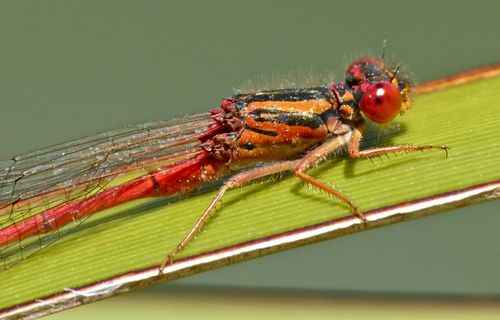
Xanthocnemis zealandica (McLachlan, 1873) is the only predominantly red damselfly found in New Zealand. Its common reference to red colour comes from the bold red base colour of males, which are marked with black patterns. Females of this species have two distinct colour variants: one is bright red with black markings at the tip of the abdomen, and the other is black with yellow stripes along the side of the abdomen. As individual damselflies mature, their colour often shifts, ranging from deep yellow to orange-red. Both damselflies and dragonflies belong to the order Odonata and share similar traits, so they are often confused with one another. A key difference between the two groups is their wing position when at rest: damselflies fold their wings vertically and upright, while dragonflies hold their wings horizontally spread out. Damselflies also have a flutterier flight than the powered hovering flight of dragonflies, so damselflies generally stay closer to the ground and do not move far from their territory. Like their dragonfly relatives, damselflies can be identified by their notably large eyes, which are disproportionate to their head size, and by distinct wing veins. Adult male Xanthocnemis zealandica are roughly 24–38 mm long, with a wingspan of 15–23 mm. Females are slightly larger, measuring around 28–39 mm long with a 18–23 mm wingspan. Nymphs of Xanthocnemis zealandica do not resemble adult damselflies. Like adults, they have disproportionately large eyes relative to their body, along with well-developed legs. Xanthocnemis zealandica nymphs lack external gills, so they breathe by pumping air out of their rectum, though they are often noted for having caudal lamellae that are sometimes described as tail gills. Despite their well-developed legs, nymphs move through water by wiggling their bodies to build momentum. Red damselfly larvae are identifiable by their pointed tail gills and long hairs at the tip of the gills. Of the six damselfly species found in New Zealand, Xanthocnemis zealandica is the most common and easiest to identify. This species is endemic to New Zealand, and is widespread and common across the North Island, South Island, and Stewart Island. It is usually abundant in any area with clean, fresh running water, and can live in a wide range of habitats, meaning it may be present in almost every lake, swamp, pond, and slow-moving stream across all three main islands of New Zealand. It is predominantly a low-altitude species, but has been recorded as high as 1,945 m (6,381 ft) above sea level. Xanthocnemis zealandica is most often found near plants growing along the edges of lakes, flowing streams, rivers, swamps, and ponds throughout the country. Its habitat range stretches from brackish coastal water habitats to alpine tarns across New Zealand. Female Xanthocnemis zealandica prefer to lay eggs in slow-moving water bodies, such as ponds, lakes, or puddles located near a larger river, though this preference differs between populations from the North and South Islands. North Island females often lay eggs in slow-moving forest streams, while South Island females generally avoid running water entirely and prefer to lay eggs in mountain tarns. Xanthocnemis zealandica has a typical life cycle of 2 to 3 years. Shorter 2-year cycles are observed at near-sea-level sites, while longer 3-year cycles are common at mid-elevation sites around 579 m (1,900 ft) above sea level. Some lowland individuals may even complete their full life cycle in just one year. Xanthocnemis zealandica undergoes incomplete metamorphosis, with three distinct life stages: egg, nymph, and adult. Xanthocnemis zealandica mates in mid-summer, with males and females grasping one another and extending their bodies to form a heart shape. This species uses an oviparous iteroparous reproductive strategy: females lay eggs that have little to no significant embryonic development inside the mother, and females can go through multiple reproductive cycles, meaning they can mate more than once in their lifetime. Copulation often occurs in flight, a demonstration of the species' strong flying ability. During mating, the male extends his lower abdomen forward to move a sperm packet to storage in his middle abdomen, after which the female bends her lower abdomen back to receive the sperm packet. This process can last anywhere from a few minutes to several hours. Adult damselflies are only active when air temperatures are high, and do not become active if air temperature falls below 14 °C. Mature females lay one egg at a time just below the water surface, while mature males patrol the egg-laying areas and sometimes form swarms. The life cycle begins when the female lays her eggs near freshwater, cutting slits into aquatic plants below the water surface or surrounding swampy ground to deposit each egg. In some cases, the female may be completely submerged for up to 30 minutes while laying eggs, while the male fends off other competing males. Unlike dragonfly eggs, damselfly eggs are cylindrical in shape. Depending on local climate and water temperature, eggs may delay hatching until water temperatures rise to improve nymph survival. After hatching in late spring to early summer, nymphs spend up to two years living among aquatic vegetation, preying on smaller aquatic organisms as they grow. Compared to dragonflies, damselflies go through fewer moults and spend less time in their aquatic nymph stage. When nymphs are ready to emerge as adults, they crawl up stems of surrounding vegetation, clay, or stones, moult out of their exoskeleton, and rest until their new wings have dried and stiffened enough for their first flight. This emergence process usually starts in the morning and can take several hours to complete. Young adults have no prior flight experience, so they are very vulnerable in open areas. For this reason, they retreat and hide in grassy areas for a few days for protection from predators. Once they reach maturity between mid-October and mid-March, they return to the water and hunt within a fixed territory, among bankside and aquatic vegetation. At night, they move 10–20 m away from the water edge to seek shelter, perching among vegetation.