About Xanthoceras sorbifolium (A.Braun) Holub
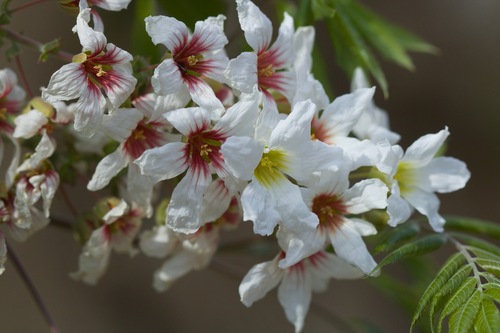
Xanthoceras sorbifolium (A.Braun) Holub is a large deciduous shrub or small tree that grows to 8 meters tall. Its leaves are arranged alternately, are 12 to 30 centimeters long, and are pinnate, with 9 to 17 leaflets. Each leaflet is 3 to 6 centimeters long, with a sharply serrated margin. The flowers are 2 to 3 centimeters in diameter, with five white petals, and grow in erect panicles 10 to 20 centimeters long in mid spring. The fruit is an oval leathery capsule 5 to 6 centimeters in diameter, which splits into three sections at maturity to release 6 to 18 seeds. The seeds are black, 1.5 centimeters in diameter, and resemble small horse chestnut seeds. The shells of the fruits and seeds are very hard, which provides the best protection during growth. Generally, X. sorbifolium only produces white flowers. During multiple crosses carried out by the Northwest X. sorbifolium base, where 56 seeds of X. sorbifolium collected from across China were allowed to naturally hybridize to increase fruit yield, an unexpected change occurred: flower color shifted from a single white to multiple colors. The leaves, flowers, and seeds of yellowhorn (X. sorbifolium) are all edible. Both the pulp and the kernel can be eaten raw or used as a cooking ingredient. The kernels have a chestnut-like taste, and both pulp and kernels are nutritious. Ripe seeds can be used to produce protein drinks. X. sorbifolium has a long flowering period, produces fragrant flowers with high nectar content and rich reducing sugar, making it a high-quality early spring nectar source in northern China. It is suitable for beekeepers to produce honey with a unique flavor. According to medical research papers on X. sorbifolium from the United States and China, fruit peel extract can inhibit cells of ovarian cancer, cervical cancer, and melanoma. The fruit husk has two main values: it serves as a raw material for furfural, which has wide industrial uses, and as a raw material for medicines that treat urinary system diseases. The oil content of whole seeds is 40%, and the oil content of kernels alone is 66.8%. The unsaturated fat content of X. sorbifolium oil reaches as high as 94%. Its saturated fat content is 1.78 times lower than that of olive oil, and 1.9 times lower than that of peanut oil. Its quality is described as better than peanut oil and sesame oil, and its health effects are described as unmatched by salad oil and olive oil. X. sorbifolium oil is rich in nervonic acid, at a content of 2.6% to 5%. According to a Shanghai medical research report, after consuming X. sorbifolium oil for 3 months, the average effective rate for treating encephalopathies including stroke sequelae, Alzheimer's disease, Parkinson's disease, cerebral palsy, cerebral atrophy, head injury, and memory loss is 92.8%. Additionally, the average tumor inhibition rate of X. sorbifolium oil on S180 tumors is 82.94%, which matches the tumor inhibition effect of cyclophosphamide, but does not carry cyclophosphamide's toxicity. The seed meal left after oil extraction is rich in protein, and can be used as a high-protein food, animal feed, or a source to extract hydrolyzed protein and amino acids. The amino acids extracted from X. sorbifolium include all essential amino acids. The nutritional value and absorption rate of X. sorbifolium protein are higher than soy protein and sunflower seed protein, and close to casein. The branches and trunk are used as medicinal material to treat rheumatism. The leaves can be used to make tea, which has diuretic properties, helps remove rheumatism, and lowers blood pressure. It is also described as having sterilizing, anti-inflammatory, fat-reducing, and antioxidant effects. X. sorbifolium leaves contain between 19.18% and 23% protein, which is higher than the protein content of black tea, and their caffeine content is close to that of scented tea.