About Xanthocarpia feracissima (H.Magn.) Frödén, Arup & Søchting
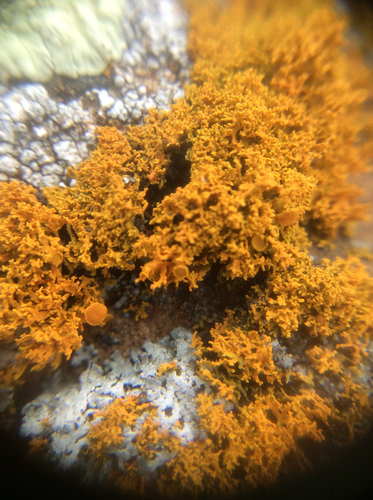
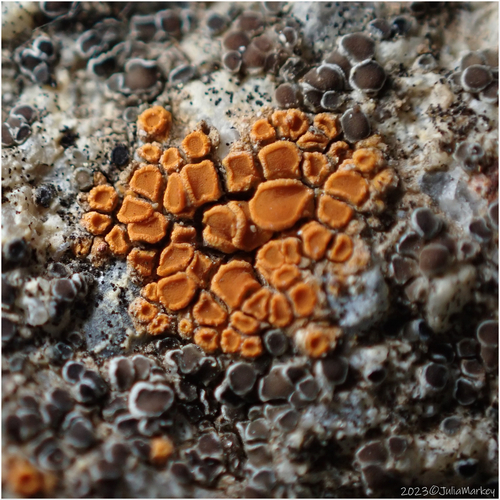
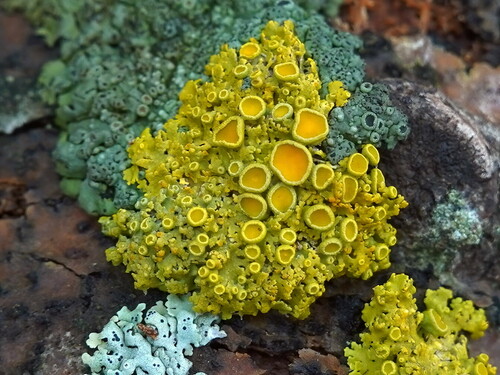
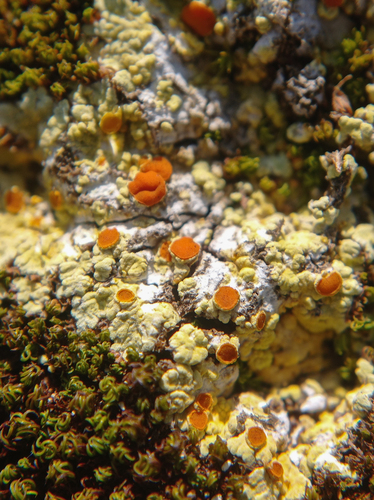
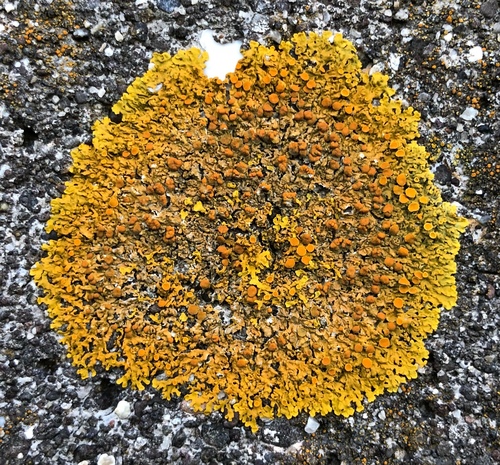
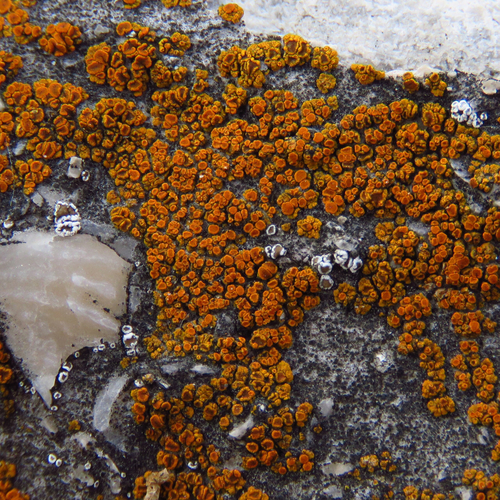
Xanthocarpia feracissima is a saxicolous, crustose lichen species belonging to the family Teloschistaceae. It was first formally published as a new species in 1953 by Swedish lichenologist Adolf Hugo Magnusson, who originally classified it within the genus Caloplaca. Its type specimen was collected in 1939 by John Walter Thomson at Lake Koshkonong, Wisconsin. In his original species description, Magnusson noted that Xanthocarpia feracissima resembles the lichen now called Gyalolechia flavovirescens, but can be distinguished by three features: it lacks a visible thallus, its discs are a sordid-reddish color, and its spores have unusually narrow septa. Following molecular phylogenetic analysis of the family Teloschistaceae, Patrik Frödén, Ulf Arup, and Ulrik Søchting reclassified this taxon into the genus Xanthocarpia in 2013. This lichen is found in the eastern United States and eastern Canada. In North America, it is commonly known by the name "sidewalk firedot lichen". It grows very commonly on cement and mortar, especially on infrequently used sidewalks. Even though its thallus is almost impossible to perceive, its tiny apothecia can grow in such dense profusion that they discolor large sections of sidewalks yellow. Because Xanthocarpia feracissima can grow on rock surfaces, there are recorded instances where it has caused damage to marble. In one documented case of statue restoration, this lichen was found to penetrate up to 10 mm (3⁄8 inch) into marble along larger cracks, and 0.05 mm (1⁄500 inch) beneath loose surface crystals, which caused the marble surface to crumble.