About Xanthium spinosum L.
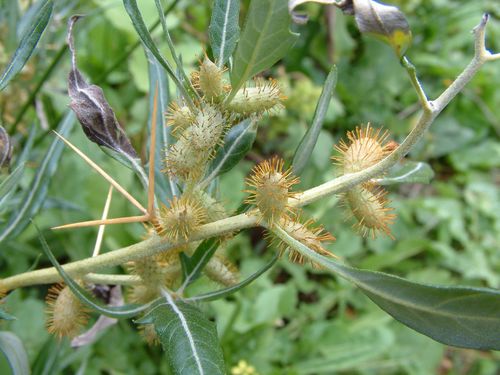
Xanthium spinosum L. is an upright, highly branched, dichotomous annual herb that grows a slender stem up to 1 metre (3 ft 3 in) tall, occasionally slightly taller. At intervals along the stem, particularly at the base of each leaf fork, it bears very long, sharp, yellowish three-pronged spines that can exceed three centimeters in length. The leaves are irregularly lobed or lance-shaped lobed, with a much longer central lobe, and have white veins running down the center. They are arranged spirally or alternately along the stem, growing up to 10 to 12 centimeters long. The upper leaf surface is dark green or grayish, while the underside is pale green or whitish, and both sides are covered in downy hairs.
Xanthium spinosum flowers from summer to late fall, typically between July and October in the northern hemisphere. This species is monoecious, producing separate male and female flower heads that form greenish, axillary or solitary inflorescence clusters. Male flowers are bulbous and grow in dense clusters at stem tips near the topmost leaves. Female flowers develop at the leaf forks of lower leaves and mature into burs. The burs measure 1 to 1.5 centimeters long, are covered in small hook-like spines, and each holds two flattened, thick-coated seeds. The spiny burs spread easily to new areas by attaching to animals, people, and objects, or by floating on water.
This plant is known worldwide as a noxious weed that grows in many types of disturbed habitats, including pastures, crops, waterways, grasslands, flood plains, and waste areas, and it sometimes grows in tropical and arid environments. Its original native range is not confirmed, but it may have originated in South America, possibly Chile. It is currently found across many regions of the world, including Canada, the United States, Central America, parts of Africa and the Middle East, China, Russia, and Australia.
Xanthium spinosum, along with other species in its genus, is used in many traditional medicinal treatments. Chloroform extracts from the plant are used to treat a range of ailments including hydrophobia, rabies, fevers, diarrhea, and cancer. In Chinese medicinal practice, methanol extracts from the plant's leaves and fruits are used to treat inflammatory diseases such as rheumatoid arthritis. This species can also be toxic to humans, as it produces toxins that cause nephrotoxic effects, resulting in kidney damage.