About Wyethia amplexicaulis (Nutt.) Nutt.
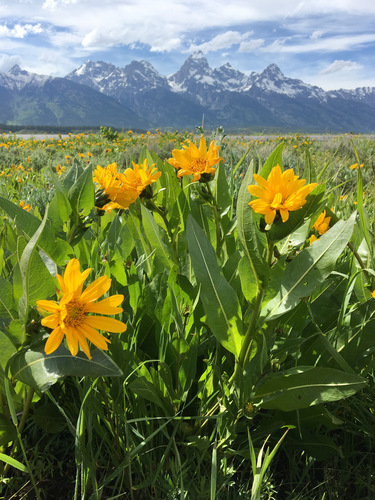
Wyethia amplexicaulis is a cool-season broad-leaved flowering forb. It usually grows 25–50 centimeters (10–19+1⁄2 inches) tall, and may occasionally reach 100 cm (39 in). It produces numerous basal leaves that grow directly from the plant base, most often 15–30 cm (6–12 in) long and sometimes reaching about 40 cm (16 in). Basal leaves are usually around 15 cm wide. They are a shining green, especially on the upper surface, due to a light resin coating (a state called vernicose). They have a smooth surface and come in a range of shapes: lance-elliptic (slightly lance-shaped, widest at the midpoint, tapering smoothly to the tip and base), oblong-lanceolate (somewhat more rectangular with more parallel sides, still with an overall lance shape), or fully lanceolate (long and narrow with a very pointed tip and tapered base). Leaf edges are most often smooth (entire), but may sometimes have small fine teeth (denticulate) or even clear teeth (dentate), and leaf edges never have hairs. Basal leaves are attached by a short petiole (leaf stem). Stem-attached leaves are the same shape as basal leaves, but get smaller the higher they grow on the stem; the highest stem leaves lack a petiole, and their base clasps the stem. Stem leaves are arranged alternately along the stem.
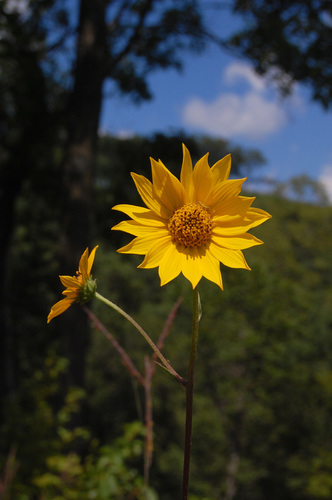
The plant flowers from May through July. Most often it produces 2–8 flower heads, though occasionally a plant will produce only one. The terminal flower head (at the end of the stem) is generally the largest, while axillary heads (growing from the point where leaves attach to the stem) are smaller. The involucre (the structure supporting the flower head) ranges in shape from half-spherical to beetroot-shaped, and is 15–30 millimeters in diameter. It has 18 to more than 36 bracts (called phyllaries), with smooth hairless faces and edges; the outer bracts are the longest, at 18–32 millimeters. Ray flowers are large, showy, and bright yellow-orange, with petals 25–60 mm long. There are usually 8 to 21 ray flowers, occasionally as many as 25.
The fruit of Wyethia amplexicaulis is technically a cypsela, a type of dry fruit that resembles an achene. Even botanical professionals often call these fruits achenes, and non-botanists such as gardeners usually refer to them simply as seeds. Each fruit is 8–9 mm long, four-sided, and has a low crown of small scales at one end. The plant has a taproot that is 4–7 cm (1+1⁄2–2+3⁄4 in) in diameter, and can reach depths of 1.8 meters (6 ft) into the soil. Lateral roots can grow to around one meter in length, not counting the main taproot. At the top of the roots is a structure called a caudex, which may be simple or branched, and is covered in buds similar to those of woody plants. All parts of W. amplexicaulis have a strong odor.
W. amplexicaulis is naturally distributed from the Pacific Northwest of the United States, mostly east of the Cascade Mountains in Washington and Oregon, to the Rocky Mountains in Montana and Wyoming. It is not known to grow in Canada, though it grows close to the Canadian border in Idaho. It grows as far south as Nevada, Utah, and northern Colorado. It grows most vigorously in at least seasonally moist meadows that are not permanently waterlogged. It can be found growing near shadscale, in sagebrush steppe, within juniper scrublands, between and in aspen groves, and in meadows in the lower montane zone. While it can grow on many soil types, it thrives on heavier soils such as clay and is more likely to become dominant on clay soils. It most often grows in flat areas or areas with gentle slopes.
Wyethia amplexicaulis is often locally abundant, forming dense populations that dominate or co-dominate alongside other species such as the grass Poa nevadensis. When an area is overgrazed, W. amplexicaulis will increase its ground cover, particularly on clay soils. Once W. amplexicaulis establishes dominance after overgrazing, it is very difficult for other plant species to reestablish in the area. Open park-like areas dominated by this plant form a dense knee-high expanse of green leaves, with only a few other species scattered within, such as Lupinus species, Drymocallis glandulosa, Potentilla gracilis, and Symphoricarpos oreophilus. Wildfires also increase the population of W. amplexicaulis in the years after fire occurs, though the immediate effects of fire on individual plants have not been documented.
Early in the growing season, tender young W. amplexicaulis foliage is eaten by mule deer, though it is not preferred forage. Similarly, sheep will eat its leaves in spring and early summer. Mature leaves are coarse and dry out by mid-summer, so the plants are not widely consumed later in the growing season. They are not much grazed by other large herbivores such as cattle and elk. However, elk, deer, and all livestock eat the flower heads with apparent enjoyment. While it is not a preferred forage plant, there are no reported cases of livestock losses from consuming it. Wyethia amplexicaulis is one of the plants consumed by Allorhinocoris speciosus, a true bug in the Miridae (leaf bug) family. Galls form on the leaves of W. amplexicaulis from the nematode Anguillulina balsamophila; the nematodes enter developing leaves on the plant's caudex and form galls as the leaves mature. Very heavily infested plants may be stunted by this.
Because they produce a showy display when mass-planted, W. amplexicaulis (also called northern wyethia) is sometimes planted in wildflower gardens. Though it provides strong early cover and growth, it is usually planted alongside other wildflowers such as blue flax (Linum lewisii), blanket flower (Gaillardia pulchella), or tufted evening primrose (Oenothera caespitosa), since it is vigorous in mid to late spring, but fades in the summer heat. In cultivation, the main propagation method for northern wyethia is seed, the same method it uses in the wild. Seeds require at least one month of cold, moist stratification at temperatures below 4.5 °C (40 °F) for successful germination. Gardeners plant seeds at an approximate depth of 6 millimeters, either directly into the soil at their final location, or in flats or pots. Plants grown in containers are moved to their planting location in the fall after one season of growth. Northern wyethia can also be propagated by root divisions taken in fall or early spring before new growth starts; each root piece must have at least one bud. Northern wyethia performs best in somewhat heavier soils such as clay-loam with moderate moisture, though it is adaptable to many soil types including gravel. It grows best in soil with a pH of 6.0–7.5, which is more neutral rather than acidic or alkaline. It is winter hardy in USDA zones 4–8.
The Goshute people of Utah have traditionally gathered the seeds of this plant as a food source. Traditionally, they used tightly woven baskets to collect seeds from mature flower heads, knocking the seeds into the basket with a wooden tool.