About Wrightia tinctoria R.Br.
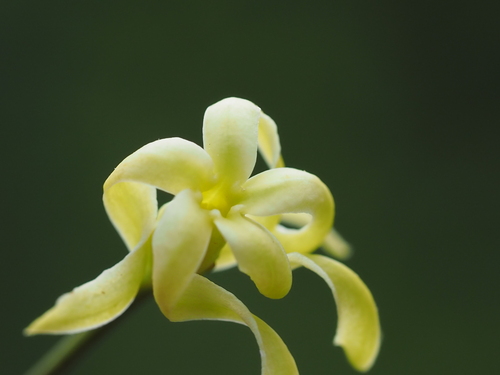
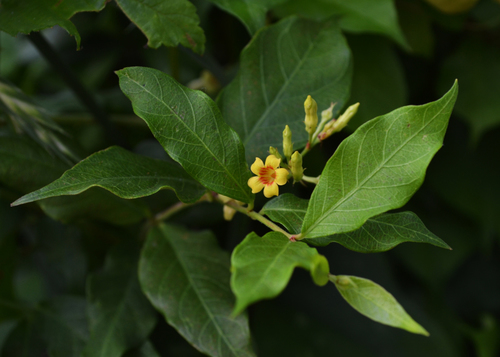
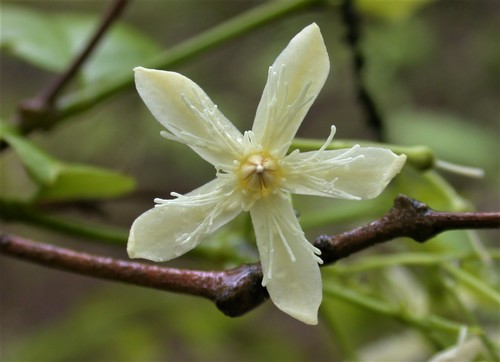
Wrightia tinctoria R.Br. is a small to medium-sized deciduous shrub or tree, typically growing 3–15 m (10–49 ft) tall, and may reach up to 18 m. It has smooth, yellowish-brown bark around 10 mm thick that exudes a milky-white latex. Its leaves are simple, oppositely arranged, ovate, and obtusely acuminate, measuring 10–20 cm long and 5 cm wide. Leaves are glabrous, and sometimes pubescent on their lower surface, with very short petioles. In India, flowers emerge between March and May, with peak blooming from April to June. White flowers are borne in corymb-like cymes 5–15 cm across at the ends of branches. Each flower has five oblong white petals 2–3 cm long that are rounded at the tip, turning creamish yellow as they age, and the flowers resemble those of frangipani. Fruiting occurs in August; fruits are cylindrical, blackish-green speckled with white, shaped like long horns that are joined at the tip. Seeds are brown and flat, with a tuft of white hairs. Seed dispersal occurs via wind, and pollination is carried out by insects. In his 1862 book on South Asian timber trees, Edward Balfour noted the species' distribution across the former Madras Presidency of British India, particularly in the Coimbatore jungles, and reported it was "very common in all forests of Bombay". In the same book, Balfour included William Roxburgh's comparison of the wood's whiteness, noting it "coming nearer to ivory than any I know". In 1824, plant specimens of this species were presented by the British East India Company to the Royal Horticultural Society; this event was illustrated and recorded in the Botanical Register, which was founded by Sydenham Edwards and at the time published by James Ridgway. It is mainly distributed across Australia, India, Myanmar, Nepal, Timor and Vietnam. Within India, it occurs across most of peninsular and central India, with the exception of northern and north-eastern states. It grows at a slow to moderate rate, and begins flowering when it is around 5–8 years old. It can grow in a wide range of soil types across arid, semi-arid, gravely, rocky, and moist regions, and is most often found on dry sandy sites, hillsides, and valleys. It responds well to coppicing, and produces root suckers. It tolerates moderate shading, and is often found growing as undergrowth in deciduous forests. It can also tolerate high levels of uranium in soil. In India, the fungus Cercospora wrightia is known to cause leaf spot disease in this species. The flowers, leaves, fruits, and seeds of Wrightia tinctoria are edible. The tree is harvested from the wild for use as medicine, and as a source of dye and timber. Its leaves are harvested as fodder for livestock. Leaves, flowers, fruits, and roots contain an indigo-yielding glucoside that produces a blue or indigo-like dye; around 100–200 kilograms of leaves are required to produce 1 kilogram of this dye. It is occasionally planted as an ornamental species in tropical regions. Branches are trampled into puddled rice paddy soil to use as green manure. It is recommended as a good agroforestry species, as it grows well when intercropped. High levels of harvesting have led to this species becoming scarce in some regions. Sap added to milk has been reported to have preservative properties, keeping the milk fresh for some time without changing its taste. In Ayurveda and other traditional medicine systems, this plant is called shwetha kutaja, and its seeds are called indrayava or indrajava. There is no high-quality clinical evidence that Wrightia tinctoria is safe for use or that it provides any beneficial health effects.