About Wollastonia biflora (L.) DC.
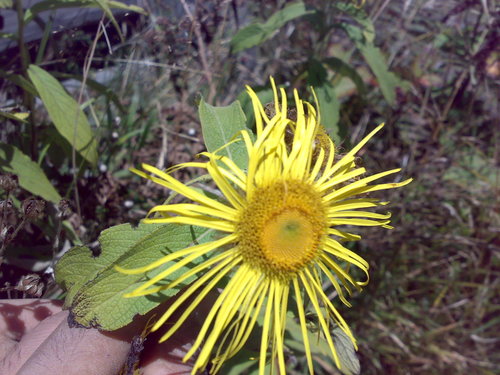
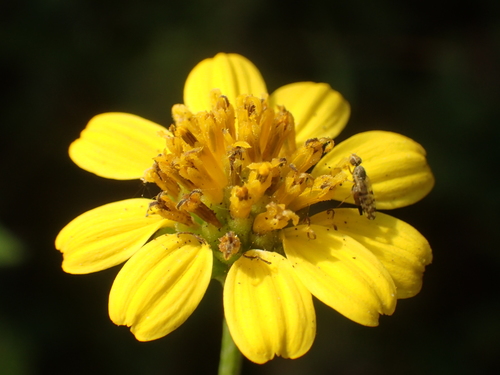
Wollastonia biflora (L.) DC. is a hardy, somewhat woody, sprawling perennial herb or subshrub. Its stems are elongate and branched, reaching up to 2 m in length, and bend once they grow to a certain height. It can scramble and straggle across the ground, or climb by leaning on other plants for support. Its leaves are ovate, with a short tapering base. It produces small yellow flower heads, with a diameter of roughly 8–10 mm, and its fruits form a dense head. This species is a moderately salt-tolerant plant that grows in the tropical belt of the Indo-Pacific region, including China, the Indian subcontinent, Southeast Asia, Taiwan, Queensland, and Pacific islands such as Fiji, Niue, Tonga, Samoa and the Cook Islands. It is most common on islands and in coastal areas, but it sometimes grows inland in neglected, unmanaged plantations and in ruderal environments. Along with Portulaca oleracea, Ipomoea pes-caprae and Digitaria ciliaris, Wollastonia biflora is typically one of the first species to colonize degraded or altered environments in tropical zones of the world. Despite its rough appearance, the leaves of Wollastonia biflora are edible. In Malaysian cuisine, the shoots are cooked and eaten as a leaf vegetable; in Langkawi, the shoots are eaten raw with chilli and sambal shrimp paste. The leaves also have traditional medicinal uses, prepared either as a poultice or a decoction. This plant has been traditionally used as a medicinal plant by many cultures, including communities in Marovo, Solomon Islands, where leaves are particularly valued for treating stomachache. In Fiji, the leaves are used to treat acne. Root extracts of this plant have anthelmintic properties, and the flowers can be used as a purgative. It is also used as fodder for rabbits.