About Wolffia arrhiza (L.) Horkel ex Wimm.
Habitat
Wolffia arrhiza is an aquatic plant that grows in still water bodies like ponds.
Frond Structure
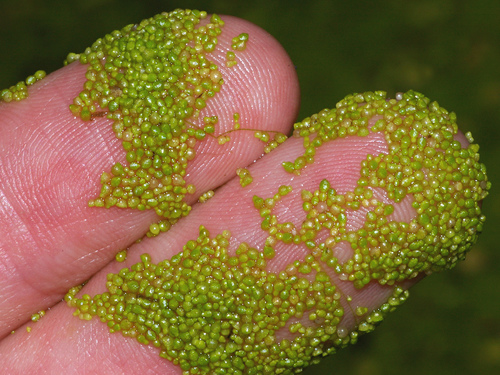
The green structure of the plant, called a frond, is spherical, about 1 mm wide, and has a flat top that lets it float on the water surface. It has several parallel rows of stomata and no roots.
Flower Structure
The plant produces a very small flower that has one stamen and one pistil.
Inflorescence Classification
Many morphologists classify this structure instead as an inflorescence made of one tiny 0.33 mm tall male flower and one single 0.3 mm diameter female flower, which is the smallest inflorescence ever reported.
Vegetative Reproduction
It often reproduces vegetatively, when a rounded part buds off to develop into a new individual.
Overwintering Process
In cooler weather, the plant becomes dormant, sinks to the bottom of the water body, and overwinters as a resting structure called a turion.
Nutrition Acquisition
As a mixotroph, it can get energy either through photosynthesis, or by absorbing dissolved carbon from its environment.
Nutritional Value
This tiny plant is a nutritious food. By dry weight, its green frond is roughly 40% protein, and its turion is roughly 40% starch.
Nutrient Composition
It contains many amino acids that are important for the human diet, relatively high amounts of dietary minerals and trace elements including calcium, magnesium, and zinc, plus vitamin B12.
Traditional Food Use
It has been used as an inexpensive food source for a long time in Myanmar, Laos, and Thailand, where it is called khai-nam, meaning "eggs of the water".
Growth Rate
The plant reproduces very quickly, growing in floating mats that can be harvested every 3 to 4 days, and laboratory tests have shown it can double its population in less than four days.
Water Treatment Use
It is also used for agricultural and municipal water treatment. It is placed in effluent from black tiger shrimp farms to absorb and break down pollutants.
Wastewater Nutrient Uptake
It grows quickly and takes up large quantities of nitrogen and phosphorus from the water.
Waste-grown Plant Use
The plants that grow in this wastewater can then be used as feed for animals including carp, Nile tilapia, and chickens.