About Wodyetia bifurcata A.K.Irvine
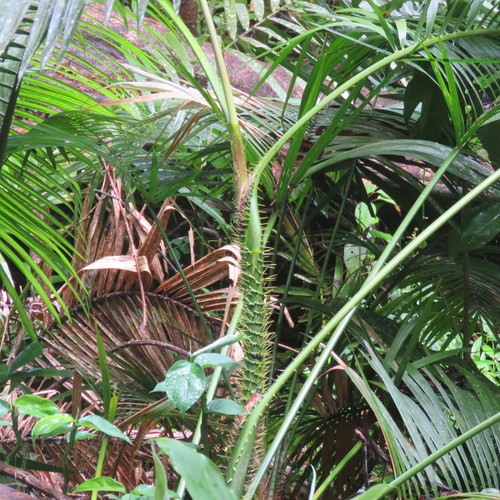
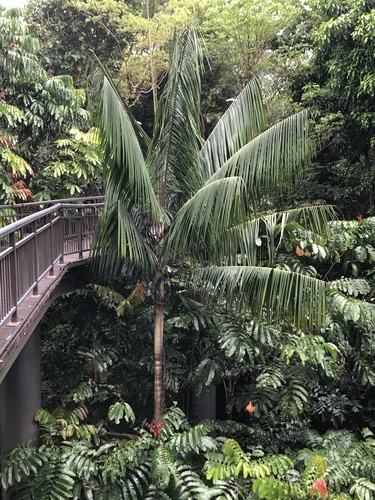
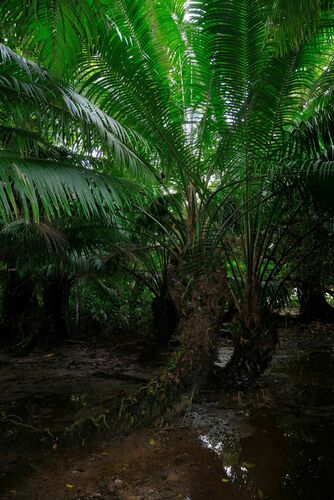
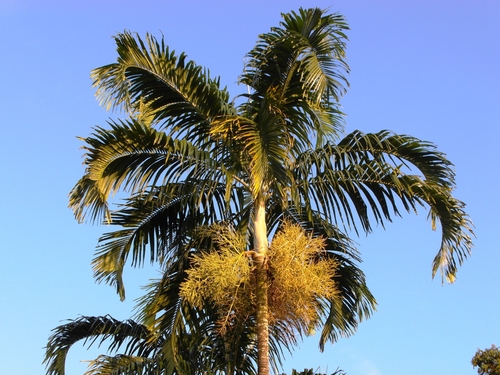
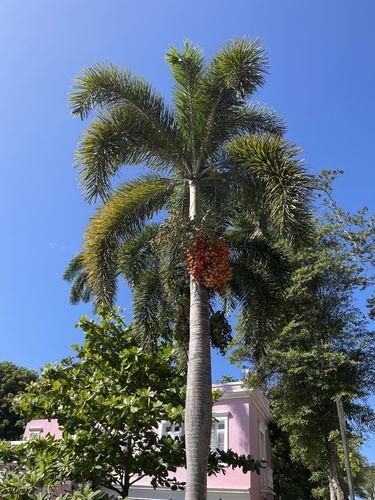
Wodyetia bifurcata, commonly known as the foxtail palm, is a single-stemmed palm species that reaches 6 to 15 meters (20 to 49 feet) in height, with a trunk up to 25 centimeters (9.8 inches) in diameter. The light grey trunk is smooth, spineless, somewhat bottle- or spindle-shaped, and marked with circular annular leaf scars. Mature trees have a crown of 6 to 10 fronds, each growing to around 3 meters (9.8 feet) in length, with a petiole around 90 centimeters (35 inches) long and a leaf sheath around 120 centimeters (47 inches) long. Its leaflets are split into up to 950 individual segments, arranged radially around the central midrib, which gives the entire frond a bushy appearance. This species is monoecious: each individual plant produces both functionally female pistillate and functionally male staminate flowers. Flowers grow on a panicle that emerges from the base of the crownshaft, and the panicle can reach up to 165 centimeters (65 inches) in length. Many flowers are clustered in groups of three, with one female flower and two male flowers per group. Individual flowers measure around 25 millimeters (1 inch) in diameter including petals, with three yellow-green petals and three green sepals. The fruit is a drupe, growing up to 6.5 centimeters (2.6 inches) long and 5 centimeters (2 inches) wide, that turns orange-red when ripe. It contains one large seed covered by a hard, fibrous, black mesocarp. This species is endemic to the Cape Melville range, located within Cape Melville National Park in Queensland, Australia. The park is extremely remote and hard to access; it sits roughly 475 kilometers (295 miles) by road north of Cairns, the nearest major population center, and most of this route consists of very challenging unsealed roads. Foxtail palms grow among large granite boulders on the southern slopes of Cape Melville, in vine thickets adjacent to rainforest. They grow on coarse sandy soils, and are the dominant species in their native plant communities. Plant species that co-occur with Wodyetia bifurcata include Buchanania arborescens, Ficus obliqua, Ficus benjamina, Myristica insipida, and climbing plants in the Capparis and Cissus genera. Near the base of the slopes, it grows alongside Corymbia polycarpa (formerly Eucalyptus polycarpa), Eucalyptus crebra (formerly Eucalyptus drepanophylla), Bombax ceiba, and Cochlospermum gillivraei. Its native altitudinal range is narrow, occurring from near sea level up to around 400 meters (1,300 feet). The area where this species grows is recognized for its rich biocultural diversity, with long, deep connections to Aboriginal peoples and high biodiversity.