About Wisteria sinensis (Sims) DC.
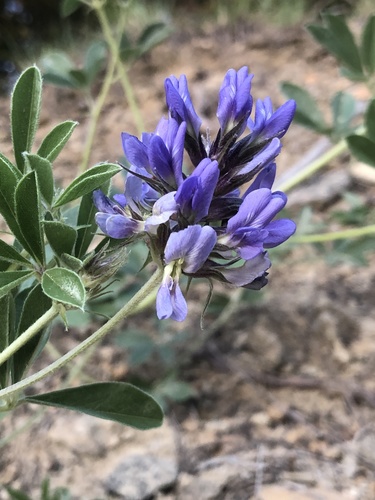
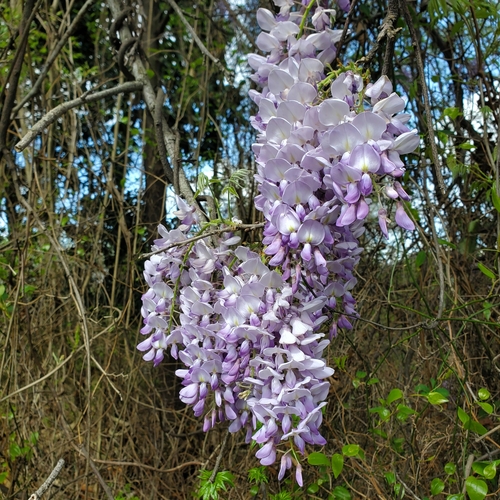
Wisteria sinensis (Sims) DC. climbs supporting plants or man-made structures using counterclockwise-twining stems. Its leaves are shiny, green, and pinnately compound, measuring 10–30 cm in total length, and hold 9 to 13 oblong leaflets that each measure 2–6 cm long. Flowers may be white, violet, or blue, and grow on 15–20 cm racemes that appear before leaves emerge in spring. All flowers on a single raceme open at the same time before foliage fully expands, and they have a distinctive fragrance similar to grape fragrance. Compared to Wisteria floribunda (Japanese wisteria), Wisteria sinensis has shorter racemes, but it usually produces a larger number of racemes. Its fruit is a flattened, brown, velvety, bean-like pod that is 5–10 cm long. Inside the pod, thick disk-like seeds around 1 cm in diameter are spaced evenly apart. The pods mature in summer, then crack and twist open to release their seeds; empty pods often remain on the plant through winter. Seed production is usually low, and most new regenerative growth of this species comes from layering and suckering. All parts of Wisteria sinensis contain a glycoside called wisterine, which is toxic if ingested. Ingestion can cause nausea, vomiting, stomach pain, and diarrhea. Cases of wisteria poisoning affecting children have been recorded in many countries, resulting in mild to severe gastroenteritis. Wisteria sinensis was unknown in Western countries before 1816, when multiple agents of the East India Company working in China sent cuttings back to England. Over the following decades, it became, and still remains, one of the most iconic ornamental vines for temperate gardens around the world. A 200-year-old specimen growing at Griffin's Brewery in Chiswick, London is commonly noted as the oldest living wisteria plant in the UK. This species has become an invasive species in some parts of the eastern United States, where the local climate is very similar to the climate of its native China. In cultivation, Wisteria sinensis is most often trained along garden walls, the exterior of buildings, or over pergolas to create avenues of overhanging blossoms when it blooms. It can also be trained to grow as a freestanding tree. Chinese wisteria is more sensitive to cold than both American wisteria (Wisteria frutescens) and Japanese wisteria (Wisteria floribunda). While its roots are hardy in USDA Zone 5 (temperatures as low as -20 Fahrenheit), the aboveground vine can suffer extensive dieback during cold snaps of this temperature. Additionally, frequent spring frosts in Zones 5 and 6 can kill dormant flower buds, so the plant may only bloom intermittently in these zones. The Sierra Madre Wisteria, a one-acre (4,000 m²) specimen located in Sierra Madre, California, is recognized by Guinness World Records as the world's largest blossoming plant. It was planted in 1892; by 1994, its branches measured 152 m (500 ft) long, covered an area of 0.4 ha (1 acre), and had a total weight of 220 tonnes (48,500 lb).