About Wisteria frutescens (L.) Poir.
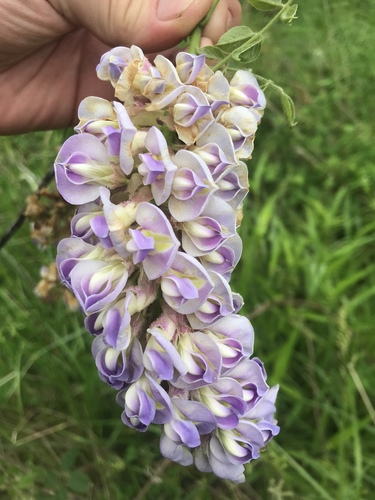
American wisteria, with the scientific name Wisteria frutescens (L.) Poir., is a flowering vine that can grow up to 15 meters long. It climbs over supports via powerful counterclockwise-twining stems. In late spring to early summer, it produces dense clusters of blue-purple, two-lipped flowers that are 2 cm (3⁄4 in) wide. These flowers grow on racemes 5–15 cm (2–6 in) long, which are the shortest racemes of any Wisteria species. Though this small raceme size has meant the plant has never been popular in many gardens, many bonsai artists use American wisteria for its manageably sized flowers, and it is an attractive flowering vine for woodland settings. Its foliage is made up of shiny, dark green pinnately compound leaves that are 10–30 cm (4–12 in) long. Each leaf holds 9–15 oblong leaflets, which measure 2–6 cm (3⁄4–2+1⁄4 in) long individually. The plant also produces numerous poisonous bean-like seed pods that are 5–10 cm (2–3+7⁄8 in) long. These pods mature in summer, persist through winter, and change appearance as they age: when young, they are fuzzy and greenish-tan, and when dry, they are shiny brown and smooth. The seeds themselves are large and brown. American wisteria prefers moist soils. It is considered shade tolerant, but it will only flower when grown in partial or full sun. It grows best in USDA plant hardiness zones 5 through 9. In the wild, it grows in woods, thickets, and along streambanks. Kentucky wisteria differs from this species: it produces slightly scented flowers that range in color from bluish-purple to white, on racemes 15–30 cm (6–12 in) long, a length that is generally average for the Wisteria genus. American wisteria can be distinguished from Asian wisteria species by several key traits. It reaches only two-thirds of the maximum height of Asian wisterias, its racemes are half the length (the shortest of the entire wisteria family), and its bloom time is sometimes shorter than many Asian varieties. Its flowers are scented, and its mature seed pods are smooth rather than velvety. In ecology, American wisteria acts as a larval host for several insect species: the butterflies long-tailed skipper, silver-spotted skipper, marine blue, and zarucco duskywing, as well as the moth Cuphodes wisteriae. All Wisteria species, including American wisteria, contain the saponin wisterin in their bark, branches, pods, roots, and seeds. There is ongoing debate about whether the flowers are toxic. The plant also contains an unknown toxic resin. Ingesting just 1 to 2 seed pods can cause poisoning, which leads to mild to severe gastroenteritis, nausea, frequent vomiting, abdominal pain, and diarrhea. In serious cases, this can lead to dehydration and collapse, but recovery generally occurs within 24 hours. Toxin concentration varies across different parts of the plant and changes across different seasons. Wisterin has a similar structure and effects to the alkaloid cytisine, but it is less potent, and it has a bittersweet taste. Like the cytisine-containing genus Laburnum, wisteria leaves are sometimes used as a tobacco substitute. Canavanine, a common α-amino-acid, is found in the seeds of all Wisteria species. It acts as a defense compound against herbivores, and provides an important nitrogen source for the growing plant embryo. Canavanine is toxic because it is extremely structurally similar to L-arginine. Organisms may incorporate canavanine into proteins in place of L-arginine, which leads to the production of abnormal proteins that may not function correctly in the body.