About Wisteria floribunda (Willd.) DC.
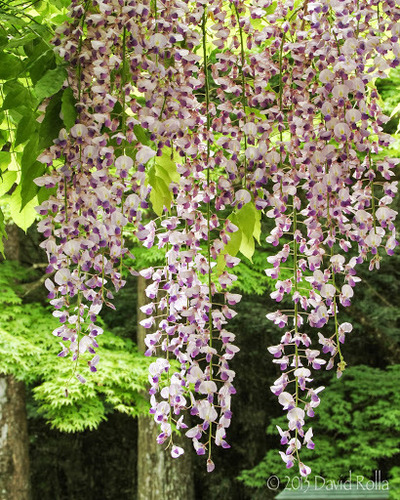
Wisteria floribunda (Willd.) DC., commonly known as Japanese wisteria (called fuji in Japanese), is a flowering plant species in the family Fabaceae, native to Japan. Note that Wisteriopsis japonica, previously synonymized as Wisteria japonica, is a distinct separate species. This plant is a woody, deciduous twining climber that typically reaches 9 meters (30 feet) in growth, though mature specimens can grow over 30 meters (98 feet) long, climbing across multiple supports via strong, clockwise-twining stems. It was first introduced from Japan to the United States in the 1830s. Along with Chinese wisteria (Wisteria sinensis), it is a very common species used for bonsai. Among all wisteria species, Japanese wisteria produces the longest flower racemes, and some cultivars have racemes that reach up to 2 meters (7 feet) in length. These racemes open into clustered blooms in white, pink, violet, or blue during early to mid-spring, and the flowers have a fragrance similar to that of grapes. Japanese wisteria's early flowering period can cause issues in temperate climates: early frosts can destroy the following year's flower buds. Like its close relative Chinese wisteria, Japanese wisteria only flowers after it transitions from a juvenile to an adult growth stage, a transition that can take many years to complete. Its foliage is made up of shiny, dark green, pinnately compound leaves that measure 10–30 centimeters (3.9–11.8 inches) long. Each leaf holds 15 to 19 oblong leaflets, with individual leaflets 2–6 centimeters (0.79–2.36 inches) long. After flowering, the plant produces brown, velvety, bean-like seed pods that are 5–10 centimeters (2.0–3.9 inches) long. These seed pods are poisonous, mature in summer, and remain on the plant through winter. Japanese wisteria grows best in moist soil and full sun, and is suited to USDA plant hardiness zones 5 through 9. Individuals of this species often live for more than 50 years.