About Wilkiea macrophylla (Tul.) A.DC.
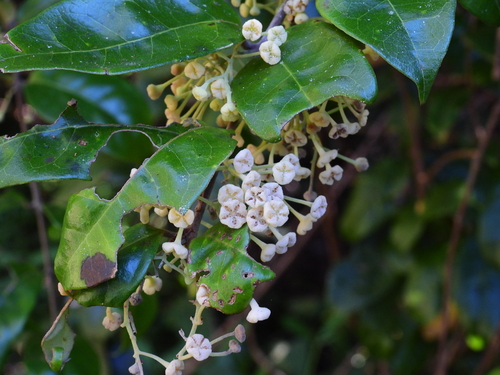
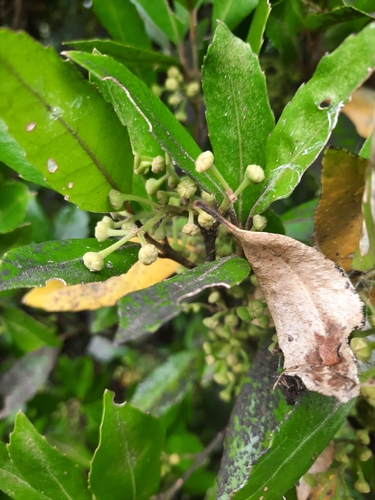
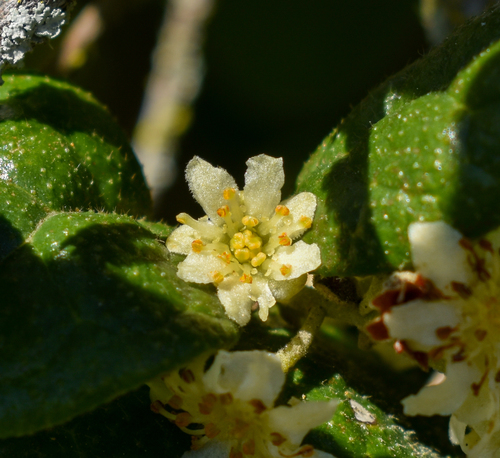
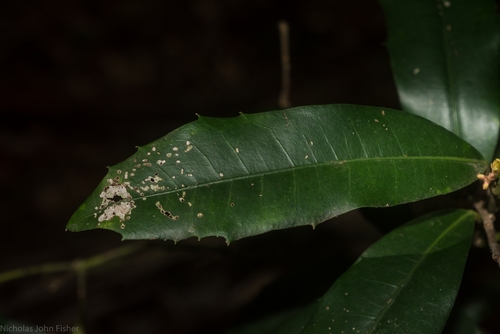
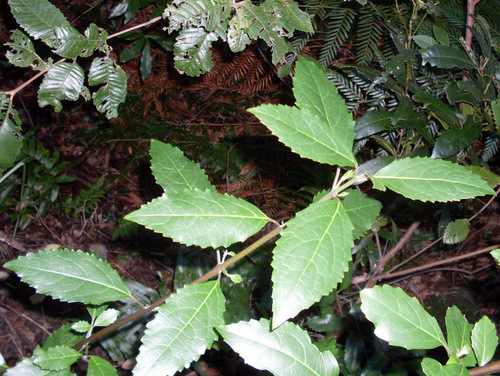
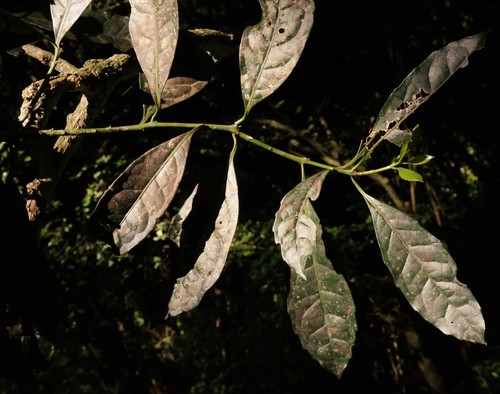
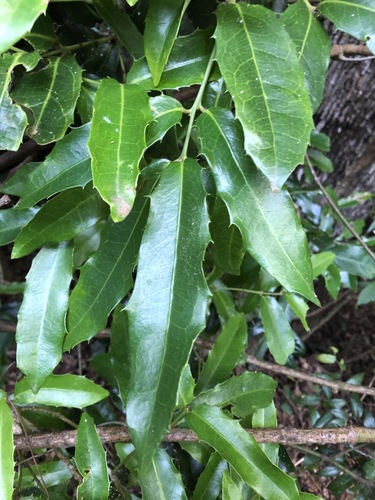
Wilkiea macrophylla, commonly called large-leaved wilkiea, is a hairless shrub or small tree that typically grows 1 to 6 meters (3 feet 3 inches to 19 feet 8 inches) tall. Its leaves range from narrowly to broadly elliptic, and are sometimes broadly oblong. They measure 65 to 240 millimeters (2.6 to 9.4 inches) long and 20 to 90 millimeters (0.79 to 3.54 inches) wide, and attach to a 2 to 10 millimeter (0.079 to 0.394 inch) long petiole. The leaves are thick and leathery, with a prominent midvein on both the upper and lower surfaces, and sometimes have prominent teeth along their edges. Male and female flowers grow on separate individual plants. Male flowers grow in groups of 3 to 9 in leaf axils, forming clusters 10 to 15 millimeters (0.39 to 0.59 inches) long. Each individual male flower is oval, 2 to 3 millimeters (0.079 to 0.118 inches) in diameter, and sits on a pedicel roughly 3 millimeters (0.12 inches) long. Most male flowers have 6 tepals and 2 pairs of stamens. Female flowers grow in groups of 7 to 9 in leaf axils, forming clusters about 15 millimeters (0.59 inches) long. Each individual female flower is a flattened sphere 3 to 4 millimeters (0.12 to 0.16 inches) in diameter, and sits on a 4 to 6 millimeter (0.16 to 0.24 inch) long pedicel. Female flowers have 6 or 7 pairs of tepals and 30 to 20 carpels. Flowering takes place from December to February. The fruit is a glossy drupe that ranges in color from purplish to olive-black, measuring 15 to 20 millimeters (0.59 to 0.79 inches) long and 10 to 12 millimeters (0.39 to 0.47 inches) wide. This species grows in rainforest at altitudes between 510 and 610 meters (1,670 and 2,000 feet), with a natural range extending from central Queensland to the Richmond River in north-eastern New South Wales.