About Wilkesia gymnoxiphium A.Gray
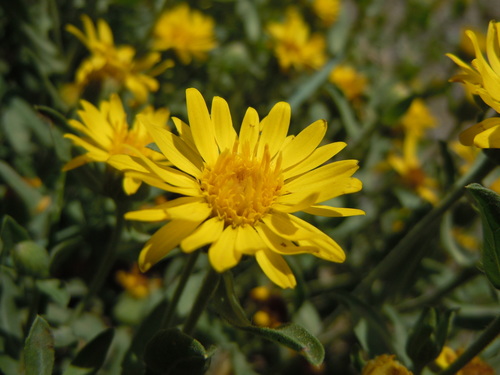
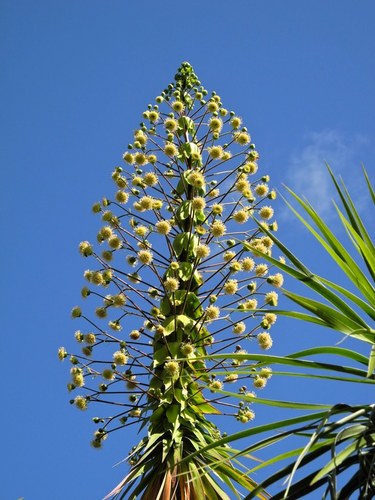
Wilkesia gymnoxiphium is a monocarpic rosette shrub, with rosettes growing atop woody stems that can reach up to 5 m (16 ft) tall. Its key distinctive characteristics are a typically unbranched, monocarpic main axis, leaves arranged in whorls of 9–20 that connect to form a basal sheath around the stem, and commonly branched peduncles. Large clusters of yellow, daisy-like flowers bloom primarily from May to July. If the plant remains unbranched, it dies after flowering. If it branches into multiple flowering heads, which often occurs when the original top is broken off, each head will flower and die individually. This species grows only on the Hawaiian island of Kauaʻi, where it inhabits dry ridges or dry to mesic forests. Its most common location is along the slopes of Waimea Canyon. It grows at elevations between 425–1,100 m (1,394–3,609 ft), in areas that get 800–2,000 mm (31–79 in) of annual precipitation. Populations in Waimea Canyon are heavily grazed by feral goats, so surviving plants are most often found on inaccessible steep slopes. A dense population of this species can be observed in a fenced enclosure located just off the road leading to Kōkeʻe State Park.