About Widdringtonia nodiflora (L.) Powrie
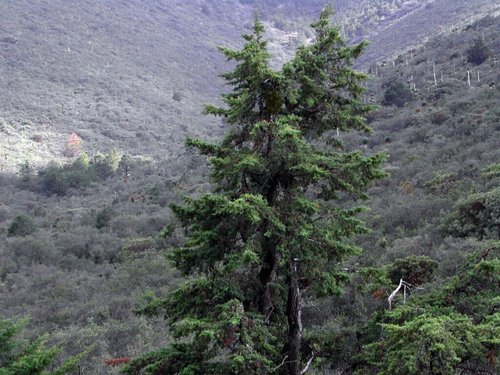
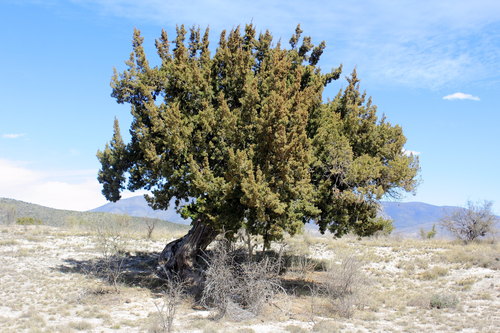
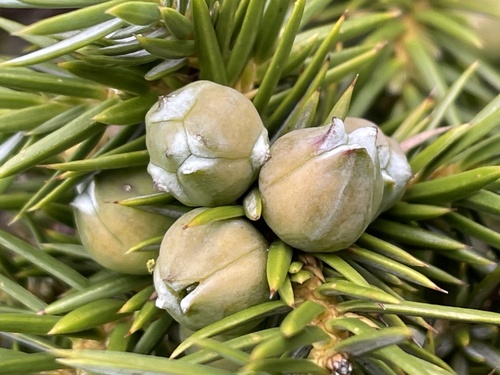
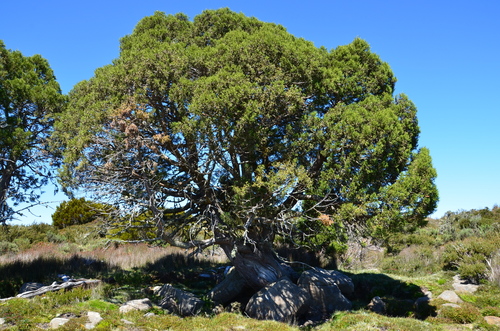
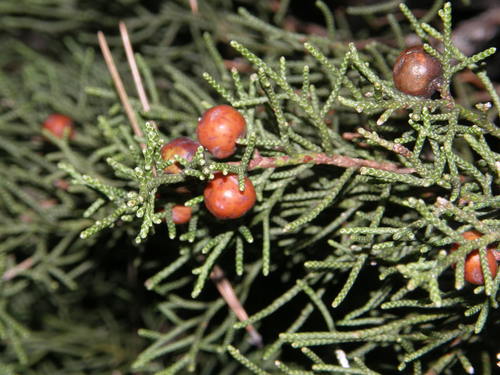
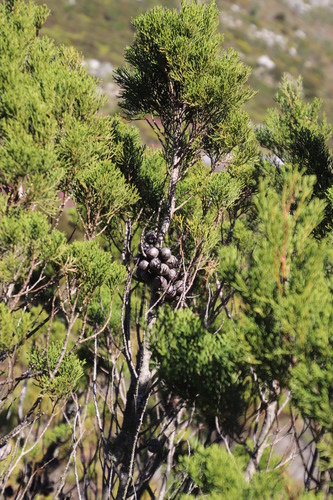
Widdringtonia nodiflora (L.) Powrie is an evergreen plant that grows as a multistemmed shrub, or a small to rarely medium-sized tree. It reaches 5 to 7 meters in height, and rarely grows as tall as 25 meters. Its leaves are scale-like: on small shoots, they are 1.5 to 2 millimeters long and 1 to 1.5 millimeters broad, while on strong-growing shoots they can grow up to 10 millimeters long. Leaves are arranged in opposite decussate pairs. The plant produces globose cones that are 1 to 2 centimeters long, with four scales, and a single tree bears both male and female cones. This species is unique within its genus for its ability to coppice: it readily re-sprouts from burnt or cut stumps. This ability lets it survive wildfires, and it is considered a major factor in why Widdringtonia nodiflora is more abundant than other species in the genus. Its wood is highly flammable, which is another adaptation to its fire-prone natural environment. It occurs naturally from Table Mountain in the south, through eastern and southern South Africa, to southern Malawi, southern Mozambique, and eastern Zimbabwe. It is the only widespread species in its genus, and the only member of the genus that is not threatened or endangered. It is closely related to the endangered cypress, called 'Cedar', of the Cederberg mountains. As its common name Mountain Cypress suggests, it is usually found at high altitudes on mountainsides, growing among rocks and in gullies. It typically grows in mountain fynbos and grassland, and normally occurs in small groups, such as the small stand of Mountain Cypress on the mountain above Kirstenbosch.