About Waynea californica Moberg
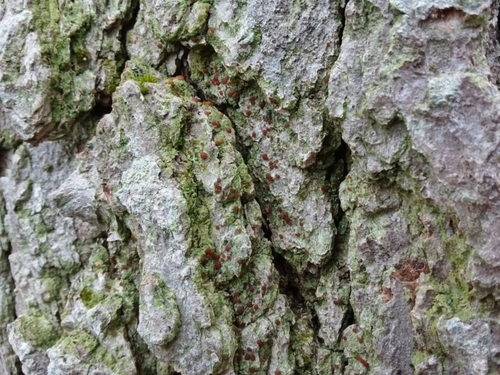
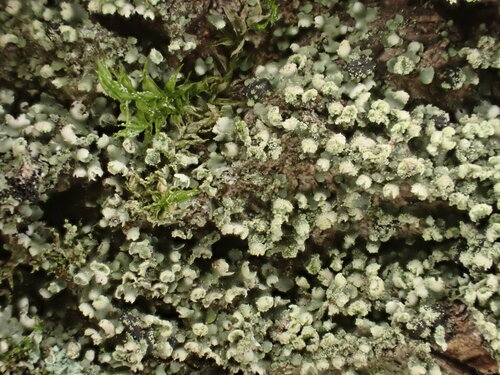
Waynea californica Moberg is a squamulose (scale-like) lichen that forms an irregular thallus. Its thallus develops in small patches that measure up to approximately 0.5 cm across, and these patches may merge to create larger colonies. Each patch contains just a few convex, upward-curving squamules that are less than 0.5 mm wide. The upper surface of the thallus ranges in color from olive-green to brown-green, and it is sometimes glossy. This surface develops pale spots that later become knob-like outgrowths, which eventually open into cup-shaped soralia. Soralia are structures that produce powdery clusters of soredia, the asexual reproductive cells used for dispersal. This lichen does not have a distinct lower cortex, and its photosynthetic partner (photobiont) is a green alga belonging to the Myrmecia type. Sexual fruiting bodies called apothecia are rare in this species; they are small, growing up to 0.5 mm across, and grow attached to short stalks. The apothecia are bluish gray with a pale, smooth biatorine margin. The internal spore-bearing layer, called the hymenium, reaches up to 80 μm in height. The spore sacs, known as asci, are shaped from cylindrical to club-shaped. Each ascus produces eight spores and has an amyloid apical dome that reacts to starch. The ascospores are colorless, elongated, with three internal cross-walls (3-septate), and measure 13–19 × 3–4 μm. No pycnidia (asexual fruiting structures) have been observed in this species, and thin-layer chromatography chemical analysis has not detected any lichen-specific substances. This lichen is currently known only from a small number of sites in California, including the Big Sur region and the Santa Lucia Mountains. It grows on the trunks of solitary trees, most commonly oaks, in relatively open roadside habitats, and can be found on both exposed and shaded trunk surfaces. The type specimen of the species was collected growing alongside other lichen species from the genera Physcia and Phaeophyscia. The combination of cup-shaped soralia and small, stalked apothecia makes this species distinctive, even though apothecia can be hard to spot: they are pale and often occur mixed in with soralia. Rare reports of Waynea californica exist from Washington, where it is proposed for monitoring as an oak-obligate indicator species in Garry oak woodlands.