About Watsonia meriana (L.) Mill.
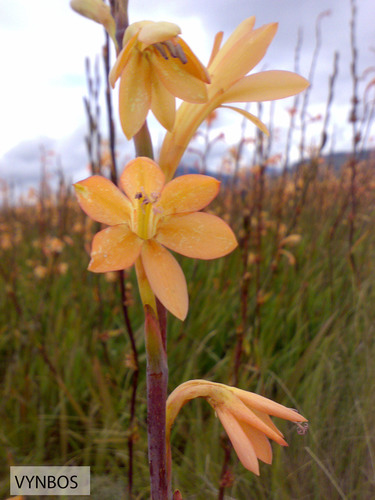
This species is a perennial herb that grows from a corm covered in a fibrous coating. When flowering, it reaches a maximum height well over one meter, and can sometimes grow up to two meters tall. Each corm produces three or four erect, lance-shaped leaves, which grow up to 60 centimeters long and 6 centimeters wide. These leaves have thickened midribs and margins. The inflorescence is an open spike holding 8 to 25 flowers, which can be any shade from orange to reddish or purplish. Individual flowers grow up to 8 centimeters long, with a long tubular throat and spreading tepals. This plant sometimes produces capsule fruits that contain seeds, but it often reproduces via bulbils—formally called cormlets—that grow in clusters in the axils of bracts at nodes along the peduncle. Dropped bulbils can sprout in soil, sometimes forming dense colonies. This is also true for sections of corm that are chopped and dispersed by plowing or non-intensive feeding from root-eating animals. In its native habitat, the plant serves as a valuable food source for local mole-rats of the Cryptomys and Georychus genera, and for Cape porcupines (Hystrix africaeaustralis). Like some other Watsonia species, W. meriana can establish as a weedy introduced species in the wild when it grows in suitable climates. It has become naturalized along the southern coast of Australia, in New Zealand, on the North Coast of California, on the west coast of Portugal, in Madeira, and in Galicia. In non-native areas, it forms dense colonies that outcompete other plant species, and is generally not eaten by local wildlife.