About Wasmannia auropunctata (Roger, 1863)
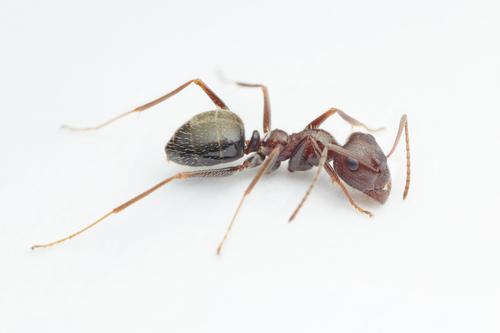
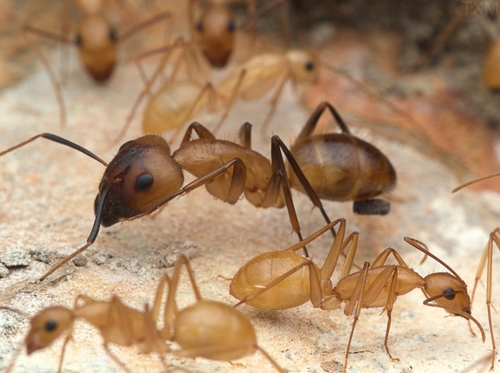
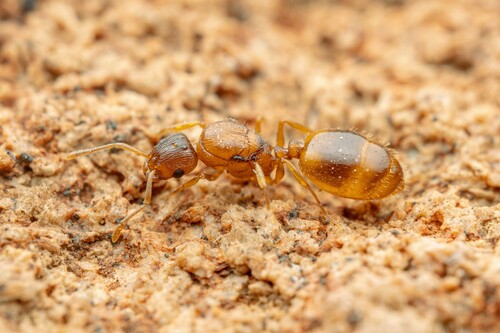
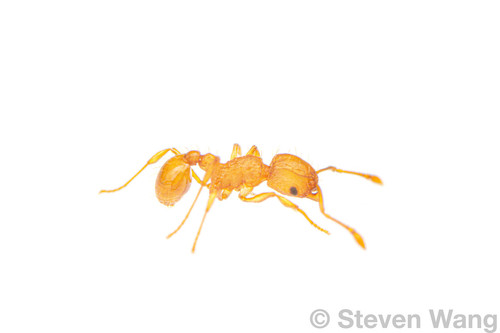
Wasmannia auropunctata (Roger, 1863), commonly called the little fire ant, has distinct physical characteristics. Worker individuals of this species are monomorphic, meaning they show no physical differentiation among workers. Workers are typically small to medium-sized, ranging from 1 to 2 mm in length. Their body color ranges from light to golden brown, and the gaster is often darker. The pedicel, the segment located between the thorax and gaster, has two parts: the petiole and postpetiole. The petiole has a hatchet-like shape, with a node that is almost rectangular in profile and higher than the postpetiole. Antennae have 11 segments total, with the final two segments greatly enlarged to form a clear club. The first antennal segment, called the antennal scape, fits into a distinct groove known as a scrobe that extends almost to the back edge of the head. The thorax bears long, sharp epinotal spines. The body is sparsely covered with long, erect hairs. This species is widely known for its painful sting, which is more severe than expected given the ant's very small size.
The reproduction of Wasmannia auropunctata follows a unique pattern. Queens produce new queens via parthenogenesis. Sterile worker ants are usually produced from eggs fertilized by males. However, in some male-fertilized eggs, fertilization triggers the removal of female genetic material from the resulting zygote. Through this process, males only pass on their own genes to produce fertile male offspring. This species is the first known animal example where both females and males can reproduce clonally, leading to a complete separation of male and female gene pools. This reproductive strategy gives the species benefits from both asexual and sexual reproduction: reproductive daughter queens inherit all of the mother's genes, while sterile workers—whose physical strength and disease resistance are important for the colony—are produced sexually.
In terms of ecology, the native range of the little fire ant covers most of South America and Central America, excluding areas with colder climates. Little fire ants are habitat generalists, and they tend to colonize human-associated areas in warm regions. Their common habitats include forest edges, managed forests, agricultural fields, and plantations. As generalist feeders, they consume other insects, decaying vegetation, seeds, and plant matter. They also feed on honeydew and form mutualistic symbiotic relationships with other herbivorous insects such as aphids. Little fire ants are effective predators; their venomous sting can subdue large insects and vertebrate prey. They establish colonies under rocks and plant litter, and they are considered a residential pest because they also form colonies in home furniture, food, and clothing. Heavy rainstorms can increase the rate of colony movement to new locations.