About Washingtonia filifera (Rafarin) H.Wendl. ex de Bary
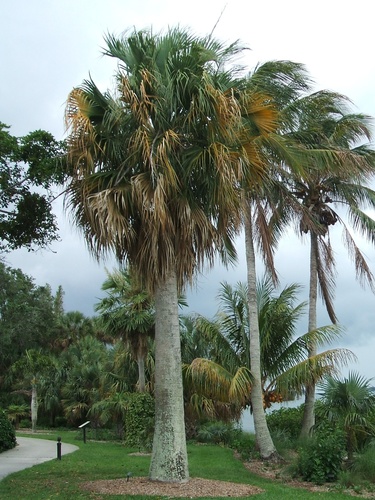
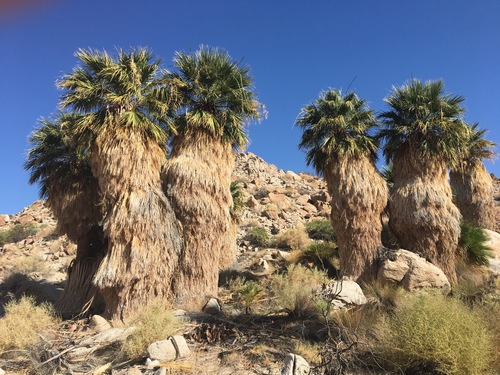
Washingtonia filifera var. filifera is a stout, single-stemmed palm that typically grows 15–20 m (49–66 ft) tall. Its trunk is usually 0.3–0.9 m (1–3 ft) thick, brown when exposed, but it is often concealed beneath a dense skirt of persistent dead fronds. If left untrimmed, this thatch may extend the full length of the trunk, providing insulation against both heat and cold, reducing fire damage, and creating shelter for small animals. The crown is typically 3–6 m (10–20 ft) across, and consists of large, fan-shaped (palmate) leaves borne on petioles up to 2 m (6.6 ft) long. Compared to the more heavily armed Mexican fan palm (W. f. var. robusta), edges of these petioles have relatively small, blunt teeth, and their bases are predominantly green rather than reddish or brown. The fronds themselves are a distinctive gray-blue-green, a color that is often used as a marker of genetic purity in the species. Between the leaf segments are long, threadlike white fibers; especially in young individuals, these filaments can resemble tufts of cotton, giving the plant its informal name "cotton palm". The inflorescences are long, branched spadices that extend beyond the fronds, and bear small, cream-colored flowers in late summer. The fruit is a black drupe about 1–2 cm (0.4–0.8 in) in diameter, which ripens in autumn and contains a single seed. Mature palms can produce thousands of fruits in a single season, and these fruits are dispersed mainly by coyotes, foxes, and birds. Coyote dispersal is especially effective: seeds are carried long distances, and show improved germination after passing through a coyote's digestive system. California fan palms typically live 80–150 years, and some individuals are estimated to reach about 200 years. They are well adapted to arid desert climates, surviving with minimal supplemental water and drawing heavily on groundwater through deep or shallow root systems that vary based on local conditions. Documented ambient temperature extremes within its native range include summer highs up to about 57 °C (134 °F), such as those recorded at Furnace Creek, and winter lows near -11 °C (12–13 °F).
Washingtonia filifera var. filifera is the only palm species native to the southwestern United States, and the vast majority of its natural populations occur in southern California. In this region, it dominates spring-fed and stream-fed oases across the Colorado Desert, with additional scattered stands in the Mojave Desert. Historically, natural oases are mainly restricted to areas downstream from the source of hot springs, though water is not always visible at the surface. It is thought that today's oasis environment may have been protected from colder climatic changes over the course of this palm's evolution. Because of this, the palm is restricted by both water and climate to widely separated relict groves. Trees in these groves show little if any genetic differentiation, shown through electrophoretic examination, which suggests that the genus is genetically very stable.
California fan palms provide habitat for the giant palm-boring beetle, western yellow bat, hooded oriole, and many other bird species. Hooded orioles rely on these trees for food and as sites to build their nests. Numerous insect species visit the hanging inflorescences that appear in late spring.
The sweet fruit pulp of this fan palm is edible. Native Americans eat the fruit raw, cook it, or grind it into flour for cakes. The Cahuilla and related tribes use the leaves to make sandals, roof thatch, and baskets. The woody petioles are used to make cooking utensils. The Moapa band of Paiutes and other Southern Paiute people have recorded memories of using this palm's seeds, fruit, or leaves for various purposes, including as famine food. The bud, known as heart of palm, is also eaten.
Washingtonia filifera is widely cultivated as an ornamental tree. It is one of the hardiest coryphoid palms, rated as hardy to USDA hardiness zone 8. It can survive brief exposure to temperatures of −10 °C (14 °F) with only minor damage, and established plants have survived brief periods as low as −17 °C (1 °F) despite severe leaf damage. The plants grow best in arid or Mediterranean climates, but can be found in humid subtropical climates such as those of eastern Australia and the southeastern United States. It has been awarded the Royal Horticultural Society's Award of Garden Merit.