About Warea carteri Small
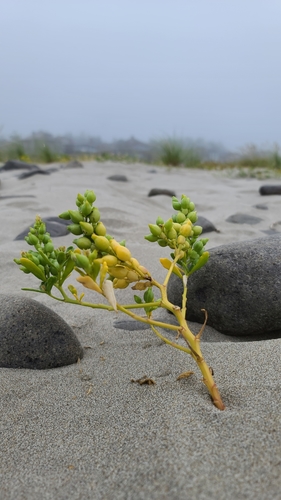
Warea carteri Small is an annual herb that grows 0.2 to 1.5 meters tall, with erect green stems. Most plants produce many slender, ascending branches that form an open, rounded crown. Its leaves do not have stipules and are arranged alternately along the stem, and lower leaves are shed by the time the plant begins flowering. Leaf size and shape vary based on the plant’s age and the leaf’s position on the stem. When the plant flowers, leaf petioles measure 0.8 to 3.9 mm, while leaf blades are 1 to 3 cm long. Leaves near stem tips are smaller, and shaped from narrowly elliptical to nearly linear, while leaves closer to the base of stems and branches are larger, and shaped oblanceolate or spatulate. All leaves have rounded tips, smooth entire margins, and bases that narrow from attenuate to cuneate. Lower leaves may also be undulate, margined, or lobed.
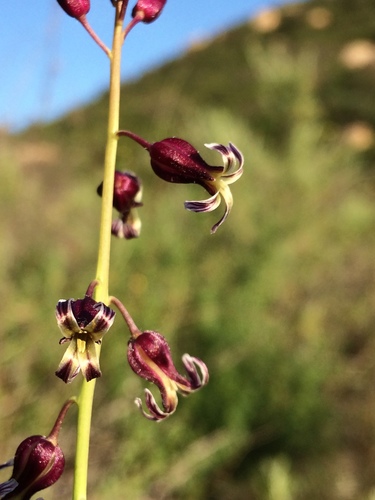
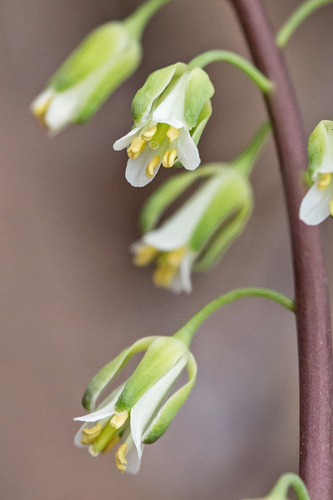
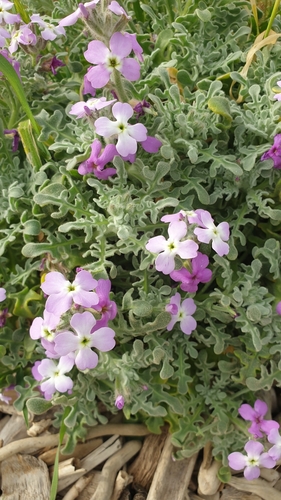
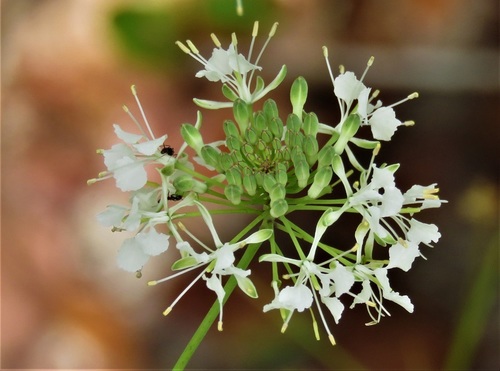
Warea carteri produces many dense, rounded raceme inflorescences, each holding 60 or more flowers. The flowers are radially symmetric, with four white linear-oblanceolate sepals around 4.5 mm long, curved toward the flower’s center at their tips. The four petals are white, around 6.0 mm long, with more than half their length forming a slender claw. The petal blade is nearly round with irregular margins. Six spreading stamens are irregularly subequal in length, growing from a nectar-producing floral disc. The ovary is superior, cylindric, around 2.3 mm long, and raised on a slender 2 mm long stalk called a gynophore. The sessile stigma has two lobes.
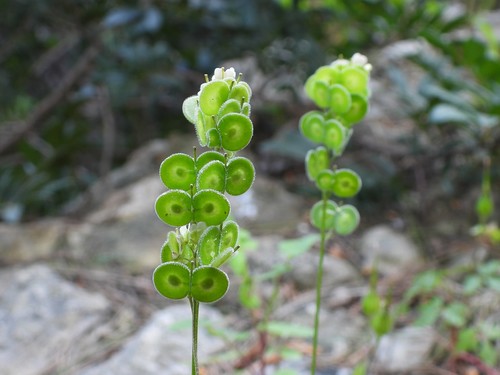
This species is protandrous: anthers begin to dehisce within one to two hours after the flower opens. Stigmas remain receptive for 2 to 4 days after anther dehiscence, by which point the flower’s stamens have dropped off. The fruit of Warea carteri is a silique: a long, slender pod divided lengthwise by a septum. The pod is flattened, cylindrical in cross-section, and gently curved along its length, measuring 4 to 6 cm long and 1.5 mm wide. The pod grows on a 5 to 6 mm long gynophore (the stalk that supports the pistil) that sits above a spreading pedicel around 8.5 mm long. The pod holds numerous oblong seeds, each 1.5 mm long. Fruits split apart passively to shed their seeds.
Historically, Warea carteri was distributed across scrubby flatwoods and sandhills of the Lake Wales Ridge in Highlands, Polk, and Lake counties; South Florida Slash Pine forests of the Miami area in Miami-Dade County; and coastal scrub in Brevard County, Florida. It has been recorded in yellow sand scrub at Lake Wales Ridge State Forest. Its currently known distribution is limited to Highlands, Polk, and Lake counties on the Lake Wales Ridge in central Florida. It may still occur in Brevard County on Florida’s Atlantic coast, though the historical sites there may have been developed.
The two largest known Warea carteri populations on the Lake Wales Ridge are located at Archbold Biological Station and The Nature Conservancy's Tiger Creek Preserve. At Archbold Biological Station, it grows in scrubby flatwoods and Turkey Oak and hickory-dominated sandhills, and is often found in the ecotone between these two vegetation types. Because sandhills here form on yellow sands, Warea carteri is often found in or near yellow sand. Several populations at this site grow adjacent to roads, fire lanes, or in areas with historic human disturbance. At Tiger Creek Preserve, it occurs in degraded sandhill habitat with abundant Turkey Oak, scrubby flatwoods, and xeric hammocks. The historical Brevard County collection was from coastal scrub, and the Miami-Dade County records are from South Florida Slash Pine (Pinus elliotti var. densa) flatwoods, where it may have shared sites with Tiny Polygala (Polygala smallii) and Miami Palmetto (Sabal miamiensis), both species that favor areas with a sandy surface rather than bare oolite.
Experiments confirm that Warea carteri is self-pollinating (autogamous) and self-compatible, a trait that allows isolated or sparsely distributed individuals to reproduce. Natural fruit-set and seed-set rates are quite high: 62 percent fruit-set and 50 percent seed-set. Experimentally self-pollinated flowers have significantly lower fruit and seed-set: 41 percent fruit-set and 28 percent seed-set, which shows that insect-mediated pollination is important for maintaining high fruit and seed-set, and high individual fecundity. Pollinators appear to be a limiting factor for fruit and seed production. Because aboveground population sizes fluctuate greatly, autogamy helps guarantee fecundity and may be an important life history trait for this species.
Germination occurs from late winter through early spring (January to March). Flowering takes place in September and October, fruiting in October and November, and seed dispersal follows in November and early December. Preliminary observations of insect activity show Warea carteri is a generalist for pollination, with a wide diversity of insect visitors including native solitary bees, bumblebees, syrphids (hoverflies or bee-flies), wasps, flies, and beetles. Insect movement most often occurs within a single plant rather than between separate plants. Combined with the close proximity of male and female stages in an inflorescence, this makes self-pollination a regular reproductive method for this species.
Warea carteri has no obvious specialized seed dispersal adaptations. Its siliques do not open explosively; instead, the outer fruit walls peel away from the central septum as the fruit slowly dries, exposing mature seeds. Seeds drop passively to the ground, or may be flung a short distance if the plant is brushed. Seeds are not likely moved by wind after reaching the ground. Seed collection or movement by ants or other animals has not been studied, and no specialized seed structures exist that would encourage this type of movement. The large fluctuations in aboveground population size suggest seed banking may play an important role in the species’ biology.
Experimental tests of germination cues conducted at Archbold Biological Station found that moisture and light are required for germination. Oak leachate did not have a significant effect on germination. Some seeds stored in dry, dark conditions for 2 years were still able to germinate, confirming that seeds can remain dormant for at least this length of time. Fire-related cues such as heat do not stimulate germination, but germination does require light, and seeds can remain dormant for more than 2 years.