About Wahlenbergia gracilis (G.Forst.) A.DC.
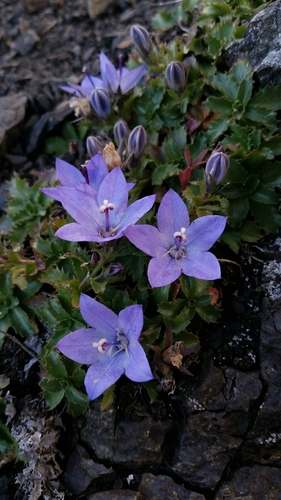
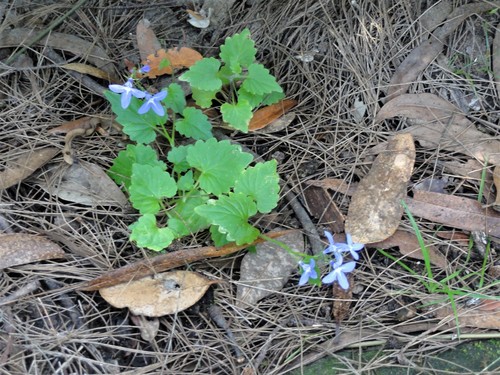
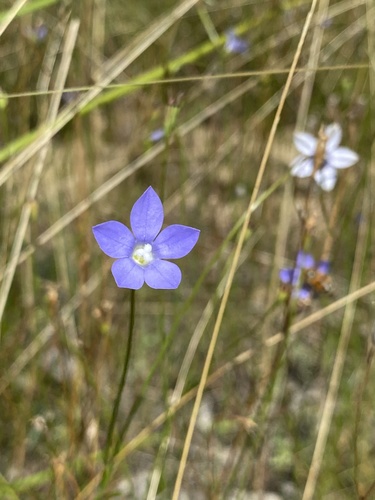
Wahlenbergia gracilis is a perennial, tufted herb that grows between 5 and 80 cm tall. It is usually erect or sprawling, and multi-branched from its basal stems, which grow from a thickened taproot. Leaves are alternate, or sometimes opposite near the stem base. Lower stem leaves are usually obovate to narrowly elliptic, while upper stem leaves are lanceolate to linear. Leaves are generally small, measuring 2 to 60 mm long and 0.2 to 10 mm wide. Leaf margins are flat or undulate, and are usually entire, sometimes bearing small callus-teeth, or occasionally serrate. Leaves are glabrous, though lower leaves may sometimes be sparsely hirsute. Conspicuous flowers are arranged in thyrsoids that occupy the upper half of the plant. Pedicels measure 2 to 11 cm long, and are glabrous or sometimes sparsely hirsute. Bracteoles are linear and glabrous. The hypanthium is obconic to obovoid in shape and glabrous. W. gracilis usually has 5 sepals, but sometimes has 3 or 4 instead; sepals are 1 to 3 mm long and narrowly triangular. The corolla is deeply campanulate, 1 to 4.5 mm long, and blue or mauve, though it may sometimes be pink or white. It usually has 5 lobes, but sometimes 3 or 4; lobes are elliptic to ovate, and 1.5 to 6 mm long. The ovary is usually 3-locular, and sometimes 2-locular. Flowers have been observed opening and closing in response to light availability. The capsule is obconic to obovoid in shape, 2.5 to 7 mm long, 1.5 to 3.5 mm wide, and glabrous. Wahlenbergia gracilis can sometimes be hard to tell apart from other Wahlenbergia species, but it is characterized by obconic to obovoid capsules, a perennial growth habit, and a deeply campanulate corolla. Wahlenbergia gracilis is native to Australia, New Caledonia, New Guinea, New Zealand and Tonga. The Wahlenbergia genus is widespread across Australia. Wahlenbergia gracilis occurs mainly across eastern mainland Australia, though it grows throughout the entire continent. It is tolerant of many vegetation types, and can be found in wet and dry forests, shrublands, woodlands and grasslands, growing in conditions ranging from moist but well-drained soil to poor, stony soils. It is well-adapted to disturbed sites. In Tasmania, it is commonly found in grasslands and grassy woodlands. Smith notes that a distinguishing feature of W. gracilis is that it is commonly found in mesic areas, meaning environments that contain a moderate amount of water.