About Wahlenbergia albomarginata Hook.
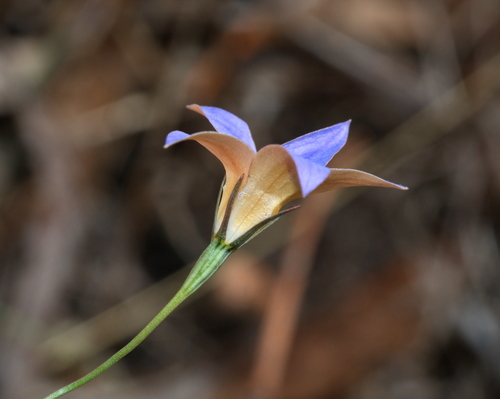
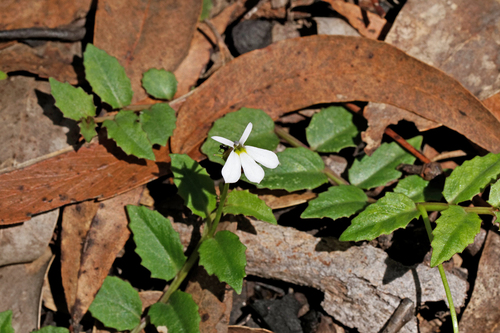
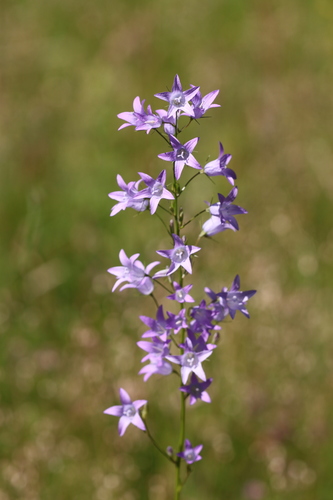
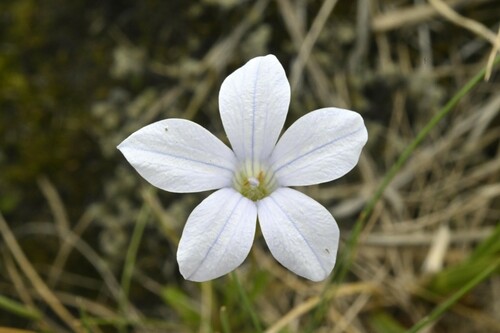
Wahlenbergia albomarginata Hook. produces bell-like flowers with a corolla shape formally described as narrow-campulate-rotate. One long-tubed flower grows at the top of each vertical, bare stem. Corolla colour typically ranges from pale blue to darker violet-blue with white patterning, and occasionally the entire corolla may be white. The corolla measures 10–20 mm in length, and its tube often lengthens from spring to summer.
Leaves of this species are 10–40 mm long. Their colour can range from yellow-green to red-green, and they may have a pale underside. Leaf margins are conspicuously white and thickened, and can be entire, toothed, or undulate; any margin teeth that are present tend to be unremarkable. Leaf shape ranges from linear to elliptic, or ovate to obovate, with the leaf blade tapering gradually toward the petiole. Leaves are typically petiolate. When plants grow in cultivation or sheltered conditions, leaves form rose-like radicle clusters around rhizome tips. In dry, windswept habitats, leaves become stiff and grow in sessile, compact tufts. Stems may become elongated when grown in low sunlight.
All Wahlenbergia species endemic to New Zealand, including this one, have glabrous pedicels and calyxes. Wahlenbergia albomarginata is a rhizomatous, herbaceous perennial plant. In cultivation, it can live for fifteen years, while individuals growing in harsh wild environments may only survive for two years. Seedlings start with a slender taproot underground, which later develops into a system of thin, flexible, interlacing rhizomes. Above-ground leafy shoots emerge from the rootstock, and eventually grow into a thin long stalk that bears a single flower at its apex.
This species is endemic to New Zealand. It occurs across the inland east coast of the South Island, in the Tasman, Marlborough, Canterbury, Otago and Southland regions, and also grows on Stewart Island. It thrives in areas with low annual rainfall, including dry lowland tussock grassland, river terraces, rocky areas, and sub-alpine habitats. It grows in well-draining riverside turf, sand, or stony soil.