About Vittadinia muelleri N.T.Burb.
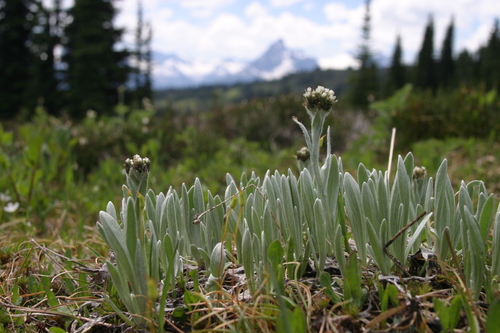
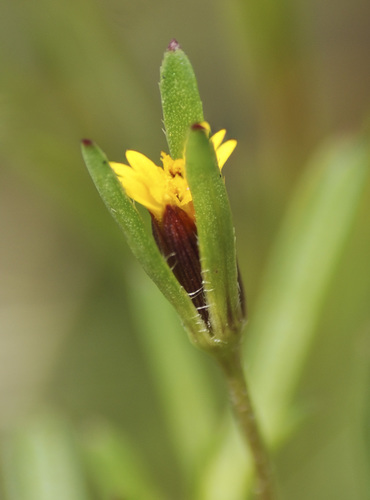
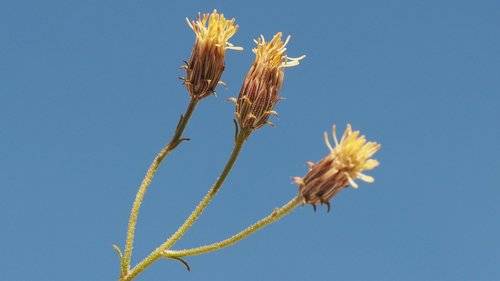
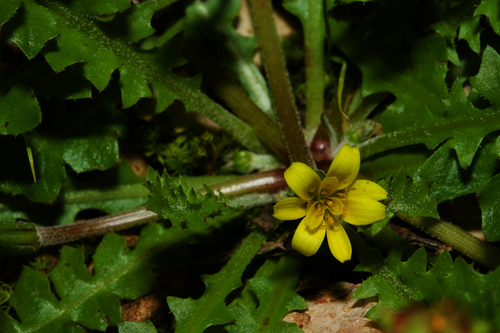
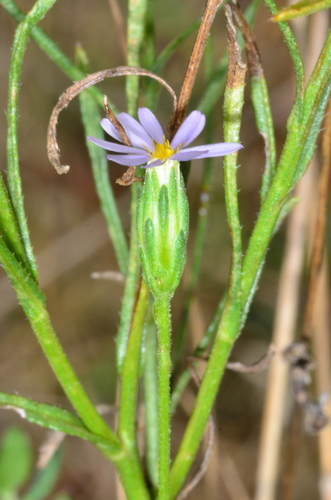
Vittadinia muelleri, also known as narrow-leaf New Holland daisy, is a perennial forb that reaches a maximum height of 20 cm (7.9 in). It grows multiple stems from its base and has a woody rootstock. Its stems are leafy, either simple or branched, and are covered sparsely or scatteredly with short, stiff, spreading hairs. The plant’s leaves are bright green and arranged alternately along the stems. They are shaped linear to narrowly oval, 8–40 mm (0.31–1.57 in) long, and 1–8 mm (0.039–0.315 in) wide. Most leaves have 1 to 3 pairs of pointed narrow lobes toward their tip, scattered rough simple hairs, and a pointed apex. Its bracts are oblong-shaped, measuring 6–8 mm (0.24–0.31 in), are almost smooth, and sometimes have small hairs along their margins. The flowers are daisy-like, purplish with a yellow centre, and about 7 mm (0.28 in) across; the ligules are 1.5–2.5 mm (0.059–0.098 in) long. Flowering occurs mostly from November to May. After flowering, it produces a flattened, wedge-shaped, ribbed cypsela fruit that is about 5 mm (0.20 in) long. This species grows in dry forests, woodlands, and grasslands in Victoria, New South Wales and Tasmania.