About Vitis tiliifolia Humb. & Bonpl. ex Roem. & Schult.
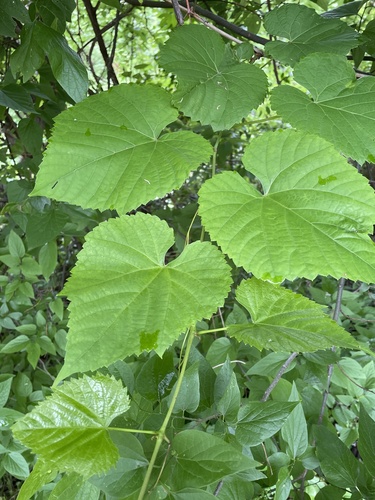
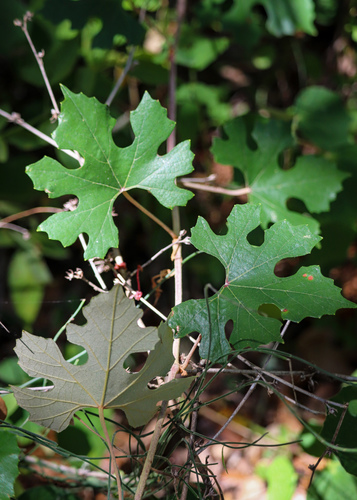
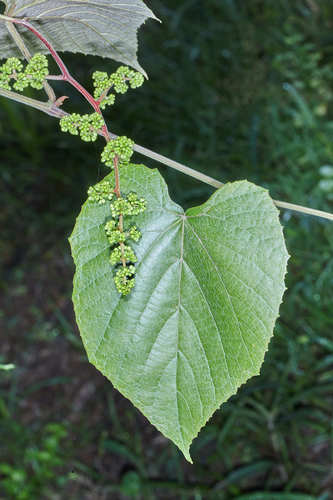
Vitis tiliifolia Humb. & Bonpl. ex Roem. & Schult. is a New World liana in the grape family, most commonly known as Caribbean grape. Other regional common names include West Indian grape, water vine, Agrá and Bejuco de Agua (used in Costa Rica), and water tie-tie and water-wise (used in Belizean Creole).
This species is native to most of Mexico, where it occurs across the states of Baja Sur, Campeche, Chiapas, Colima, Durango, Guanajuato, Guerrero, Hidalgo, Jalisco, México, Michoacán, Morelos, Nayarit, Oaxaca, Puebla, Querétaro, Quintana Roo, San Luis Potosí, Sinaloa, Tabasco, Veracruz and Yucatán. It is also native to many other countries and regions across the Americas and the Caribbean, including Belize, Colombia, Costa Rica, Cuba, the Dominican Republic, Ecuador, El Salvador, Guadeloupe, Guatemala, Haiti, Honduras, Jamaica, Nicaragua, Panama, Puerto Rico, the U.S. Virgin Islands and St Lucia. In Costa Rica, it is most common between 500 and 1,000 meters in altitude.
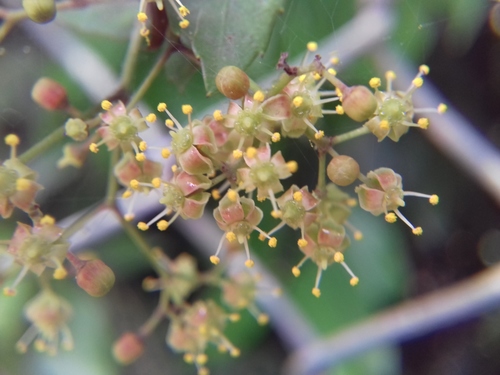
Vitis tiliifolia is grown as a forest crop in Mayan agriculture, and its products are used for food, drink, and as an ingredient in medicines. This vine species is most commonly dioecious, meaning individual vines produce only male or only female reproductive structures, though wild hermaphrodite vines have been recorded. Flowering typically occurs at the start of the dry season, which falls in December for populations in the northern hemisphere. In cultivation, individual vines can produce up to 20 kg of fruit. The fruits are small, acidic, and low in sugar, measuring around 8 Brix. They are sometimes used to make wine that resembles wine produced from the Norton grape, a variety native to east and central United States. Cultivated Vitis tiliifolia vines are vigorous, similar in growth to Muscadine grapes, so they require ample trellis space of around 6 meters, or 20 feet. Like other grape varieties, Vitis tiliifolia can and should be pruned, and can be propagated from cuttings.