About Vitex rotundifolia L.f.
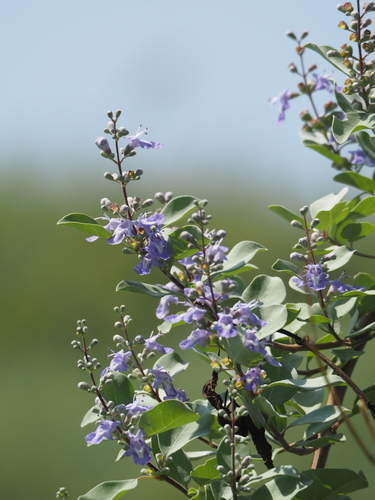
Vitex rotundifolia L.f. is a sprawling shrub that reaches a maximum height of 1.5 m, and typically grows between 0.5 and 1 m tall. Thanks to rapid nodal rooting, it can form dense mats that extend more than 10 m away from the original parent plant. This species grows along sandy and rocky coasts, at elevations between 0 and 15 m above sea level, and grows all the way down to the edge of ocean waves. It is highly tolerant of the harsh conditions of beach dune environments, including intense heat, strong wind, coarse-textured soil, and high salinity. Its natural native range covers most of the Pacific Rim and many Pacific islands. Munir recorded it growing in Northern and Western Australia, New Guinea, Indonesia, New Caledonia, Polynesia, Hawaii, Malaya, Philippines, and Hong Kong. Moldenke reported it growing in Brazil, Mauritius, Reunion, Bangladesh, Sri Lanka, Andaman Islands, China, Taiwan, Japan, Ryukyu Islands, Korea, Indochina, Thailand, Borneo, and Sarawak. It has also been observed growing in southern India. Cultivation of this species has been documented in England, Florida, Germany, the Hawaiian Islands, Hong Kong, Java, Johnston Island, Maryland, and New York. In the United States today, beach vitex is only fully naturalized in the southeastern states along the Atlantic and Gulf coasts. Beach vitex is a perennial plant that grows throughout the summer in temperate and tropical regions of the Pacific. In temperate areas, it is deciduous, dropping its leaves during cool fall nights. In the southeastern United States, new leaves emerge in April, flowering takes place from June to August, and fruiting begins shortly after flowering. Fruits can stay attached to the plant through early spring. Vitex rotundifolia can survive winter on dunes in North Carolina, South Carolina, and Gulf coastal areas, and grows well in USDA hardiness zones 6b to 10. Because the anthers and stigma are spatially separated, self-pollination is unlikely, and pollen transfer is most likely achieved through visits from insects. On Nishino-shima Island, researcher Abe recorded that flies, honey bees, beetles, butterflies, and ants all visit Vitex rotundifolia flowers, with ants being the most common visitor. A diverse range of pollinators visit the flowers to access the 0.5 μL of nectar produced per flower. Due to this wide variety of visiting insects, the plant does not likely need a single specialist pollinator species for successful pollination. Vitex rotundifolia has a number of medicinal uses, which generally match the medicinal uses of Vitex agnus-castus.