About Vitex pinnata L.
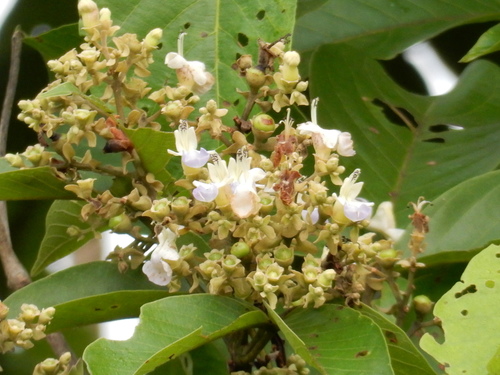
Vitex pinnata L. has fissured, flaky bark that ranges from pale yellowish grey to brown. Its inner bark is pale yellow, and turns green when exposed to air, while the sapwood is soft yellow to brown. Its leaves are 3- or 5-foliolate; leaflets are almost sessile. The outer two leaflets are usually much smaller than the others, and are shaped ovate or elliptic. Leaflets measure 3–25 cm long and 1.5–10 cm wide, with a base that is rounded to slightly wedge-shaped. The leaf apex is acuminate, the margin is entire, and secondary veins occur in 10 to 20 pairs. Its inflorescences are terminal panicles, and the flowers are whitish blue. The fruits are 5–8 mm in diameter, and ripen to black. Vitex pinnata L. is distributed across the Indo-Malaysia region, where it occurs in Borneo, Sabah, Sarawak, and throughout Kalimantan. It can also be found in India, Sri Lanka, and Cambodia; in the Philippines, this species is only known from the islands of Palawan, Culion, and Tawi-Tawi. This species typically grows well in secondary forests, on riverbanks, along roads, and on marginal land such as Imperata cylindrica areas. It appears to tolerate regular fires. In tropical conditions like those found in East Kalimantan, flowering and fruiting occurs nearly continuously from January to December. Its fruits are eaten by birds, and its seeds require light to germinate. The wood of V. pinnata is strong, durable, and remains durable even when in contact with water or soil. The wood is grayish brown in color, with a density of approximately 930 kg per cubic metre (58 lbs per cubic foot). It is used for posts, door and window frames, beds, furniture, and knife handles. The leaves and bark of this species are used to treat abdominal pain, fever, and malaria.