About Vitex negundo L.
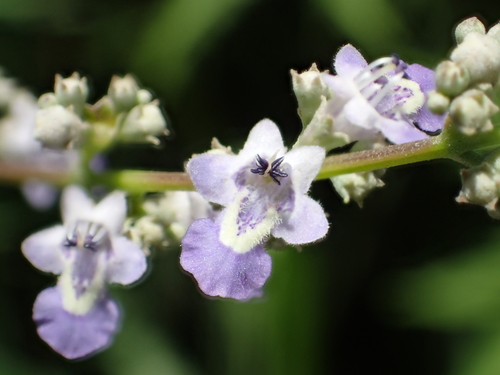
Vitex negundo L., commonly known as the Chinese chaste tree, five-leaved chaste tree, horseshoe vitex, or nisinda, is a large aromatic shrub with quadrangular branchlets that are densely covered in whitish tomentose hairs. It is widely used in folk medicine, especially in South and Southeast Asia. This species grows as an erect shrub or small tree, reaching heights between 2 and 8 meters (6.6 to 26.2 feet). Its bark is reddish brown. Leaves are digitate, most often with five lanceolate leaflets, though sometimes only three. Each leaflet measures around 4 to 10 centimeters (1.6 to 3.9 inches) in length; the central leaflet is the largest and has its own stalk. Leaf margins are toothed or serrated, and the underside of each leaflet is covered in hairs. Numerous flowers grow in panicles 10 to 20 centimeters (3.9 to 7.9 inches) long. Individual flowers are 6 to 7 millimeters (not centimeters) long, and range in color from white to blue. Its petals vary in length, with the middle lower lobe being the longest. Both the corolla and calyx are covered in dense hairs. The fruit is a succulent drupe, 4 millimeters (0.16 inches) in diameter, with a shape ranging from rounded to egg-shaped. Ripe fruits are black or purple. Vitex negundo is native to tropical Eastern and Southern Africa and Asia. It is widely cultivated and has become naturalized in many other regions. It is indigenous to Afghanistan, Bangladesh, Bhutan, Cambodia, China, India, Indonesia, Japan, Korea, Kenya, Madagascar, Malaysia, Mozambique, Myanmar, Nepal, Pakistan, the Philippines, Sri Lanka, Taiwan, Tanzania, Thailand, and Vietnam. It is commonly found growing near bodies of water, on recently disturbed land, in grasslands, and in mixed open forests. Purified extracts of Vitex negundo are believed to have medicinal properties. The plant is used to protect stored garlic from pests. In the Philippines, it is approved by the Department of Health as one of ten official herbal medicines used as a cough remedy, and is sold under the trade names Ascof, Plemex, and Lagundex. In Malaysia, it is used in traditional herbal medicine for women's health, including treatments to regulate the menstrual cycle, manage fibrocystic breast disease, and as a post-partum remedy.