About Vitex lignum-vitae A.Cunn. ex S.Schauer
Size Characteristics
Vitex lignum-vitae is a small to medium tree that can reach 30 metres (98.4 ft) in height, with a trunk diameter of up to 90 cm (2.95 ft).
Trunk Appearance
Its trunk is creamy or brown, marked with horizontal lines and fissures, and its bark sheds in small flakes.
Trunk Base Structure
Larger trees develop flanges or buttresses at the base, and their main bole has an irregular shape.
Juvenile Leaf Morphology
Juvenile leaves and leaves from coppice growth are lobed or angled.
Mature Leaf Morphology
Mature leaves are opposite, simple, shiny, and untoothed, measuring 5 to 13 cm long, and are often broader toward the tip.
Leaf Stalk Characteristics
Leaf stalks are 15 to 25 mm long, hairy, and channeled on the upper surface.
Leaf Vein Features
Net-like veins are visible on the underside of the leaf, and small foveolae (raised hairy bumps) form where the midrib meets the larger lateral veins.
Branchlet Characteristics
Branchlets are grey, hairy, and somewhat four-sided in cross-section.
Flower Appearance and Timing
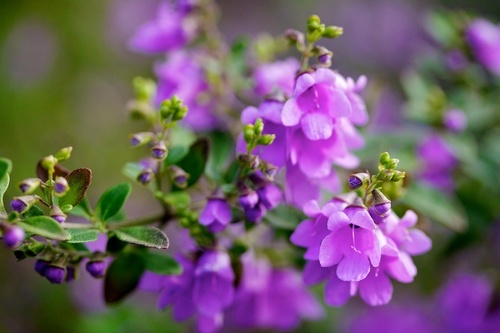
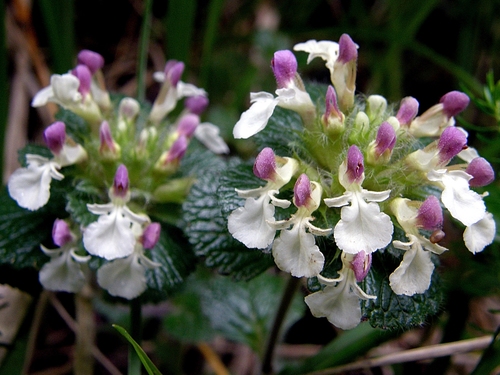
Pale purple flowers grow in cymes and can appear at any time of year, most commonly in April.
Fruit Morphology
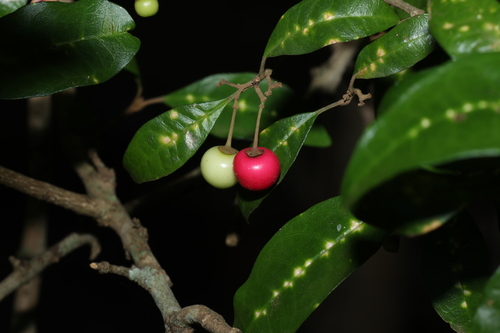
The fruit is a red drupe 8 to 12 mm in diameter, holding a round hard capsule inside.
Seed Capsule Structure
The capsule is divided into four cells, each containing either a fertile or infertile seed.
Fruit Ripening and Dispersal
Fruit ripens between November and April, and is eaten by birds including the green catbird and rose-crowned fruit dove.
Seed Regeneration Rate
Regeneration from seed is unusually slow and difficult.
Propagation Preparation
The fleshy aril must be removed from the fruit capsule, and older fruit is preferred for propagation.
Germination Timeline
Roots and shoots can take two or more years to appear after sowing.