About Viola sororia Willd.
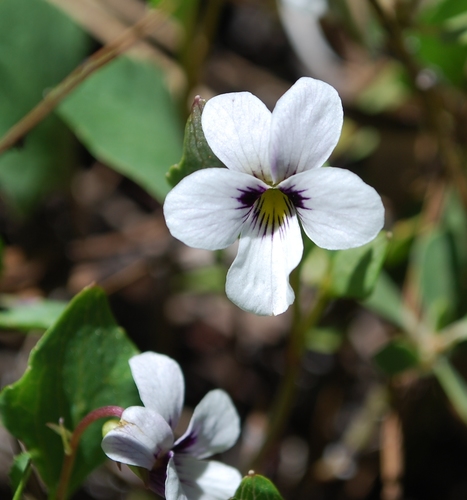
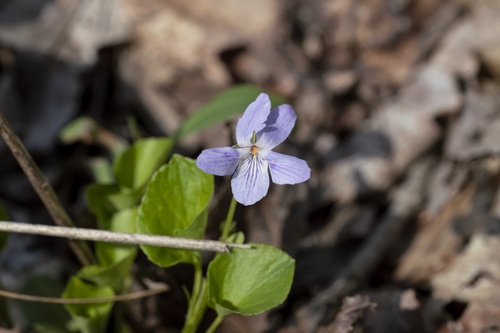
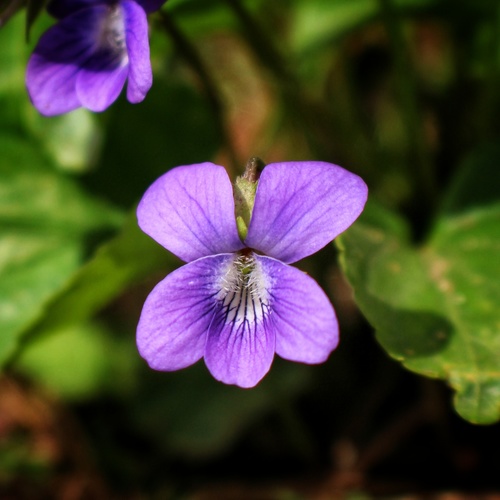
Viola sororia Willd. is a short-stemmed herbaceous perennial violet that grows 15–25 centimeters (6–10 inches) wide. It has glossy, heart-shaped leaves, and bears flowers with slightly drooping stems. Flowers typically have purple petals with white throats, and the lower three petals are hairy; blooms can also be white or blue. It blooms from spring to summer, between April and August. This species lives and reproduces for over 10 years, and can be found growing in woods, thickets, and near stream beds. It is found primarily in forests, growing on forest floors. It grows in well-drained, shady habitats, and can also adapt to sunny or partly shady conditions. Its preferred soils are moist, rich, and well drained. Leaves develop in early spring before surrounding tree crowns fully close, and continue growing even after the forest canopy closes. Viola sororia is interfertile, meaning it can and is likely to breed with other closely related Viola species. In ecology, caterpillars of fritillary butterflies including the great spangled fritillary and variegated fritillary are dependent on this plant and other species in the genus Viola. The plant acts as food for wild turkeys, rabbits, deer, livestock, mourning doves, bobwhites, and white-footed mice. In spring, native bees such as mason bees, sweat bees, and the violet specialist mining bee visit this plant for its nectar. Butterflies also pollinate the species. After pollination, Viola sororia produces seeds via normal dispersal like most flowering plants, but in late summer it also produces seeds through cleistogamy, a process where it self-fertilizes internally without opening its flowers. Its seed capsules eventually turn upright, open, and shoot seeds up to 2.7 meters (9 feet) away from the parent plant. This species also uses myrmecochory, or seed dispersal by ants. Its seeds are coated with elaiosomes, which are protein- and lipid-rich morsels that attract ants. Ants collect the seeds and carry them back to their nests. After the ants consume the elaiosome coating, they discard the seeds in their waste piles where the seeds can germinate. Viola sororia has low fire tolerance, no known toxicities, and no serious insect or disease problems. Its foliage usually declines during hot summers. Its leaves and flowers are edible in moderation, and it is safe to plant around pets. Beyond being a common lawn and garden plant, it is used to decorate walkways and park areas, and is planted as a wildflower in lawns. Even though it is a resource for pollinators and an important host plant for various fritillary butterflies including greater fritillaries of the genus Speyeria, some people consider Viola sororia a weed. Historically, it has been used for food and medicine. It is high in vitamins A and C. Young leaves and flower buds can be eaten raw or cooked, or brewed into tea. The flowers and leaves are edible, and some sources note that the roots are also edible. The Cherokee people used it to treat colds and headaches. In his 1828–1830 work Medical Flora, a Manual of the Medical Botany of the United States of North America, Rafinesque recorded that contemporary Americans used Viola sororia to treat coughs, sore throats, and constipation. It has also been reported to act as an anti-inflammatory, and has been used topically for skin conditions. This plant is deer resistant.