About Viola ocellata Torr. & A.Gray
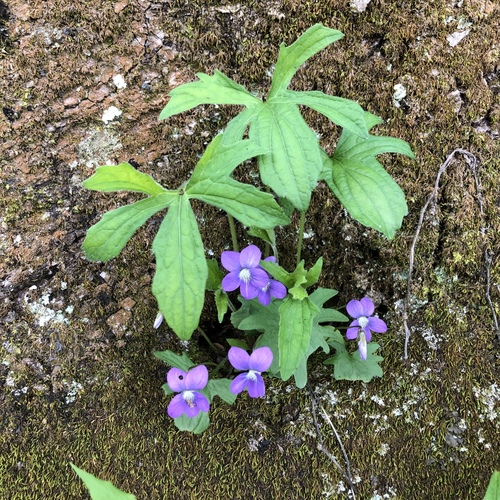
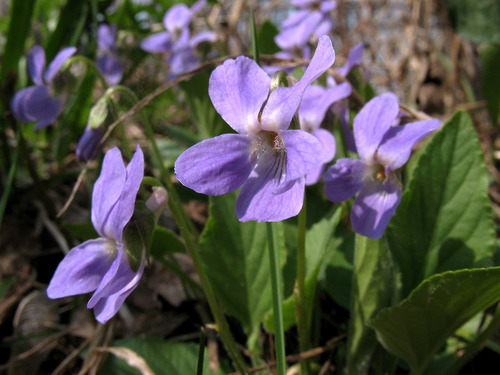
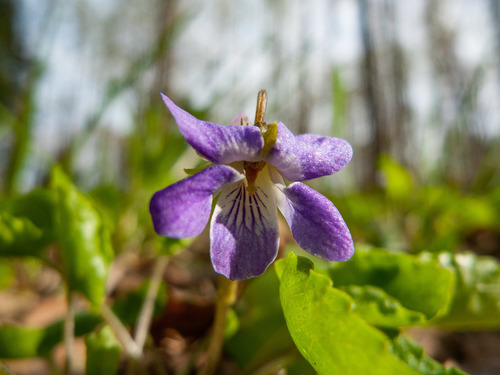
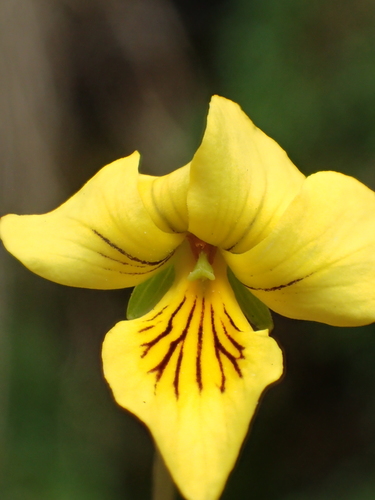
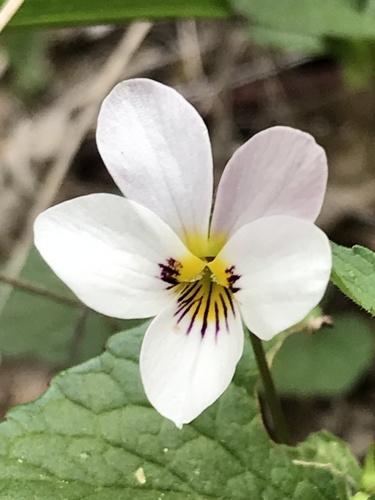
Viola ocellata Torr. & A.Gray is a perennial herb that grows in shaded woodland areas with moist, slightly acidic soil. It is most often found growing on rocky or grassy banks, in thickets, and in redwood or pine forests. This species gets its name from its characteristic feature: two dark purple spots at the base of its two innermost petals, which create the appearance of two eyes. It reproduces both by seeds and by rhizomes, with new plants growing directly from its root system. The entire plant ranges from 2 to 37 centimeters in height, and ranges from glabrous to puberulent in texture. Its stems are erect to ascending, growing from a rhizome that lies shallow to deep underground. The leaves are simple and cordate, with crenate to serrate margins, and grow on petioles 0.4 to 10 centimeters long. Its inflorescence is axillary, with a single flower held on a peduncle 1 to 10 centimeters long. The perianth has 5 lanceolate, ciliate sepals, and 5 petals that appear white from the front, fading to yellow toward the center. The top two petals are dark purple on their reverse side. The bottom petal has dark purple veins running across its base. The two innermost side petals have the species' characteristic dark purple spots at their base. Fruits are round to ovoid capsules 5 to 8mm long, which split open directly into three locules, a trait typical of the Violaceae family. Its seeds are round, brownish-purple, and roughly 2 millimeters in diameter. The rootstocks are fleshy, and often long and stolon-like. In ecology, this species is of low importance as a pollen and nectar source for bees, but is moderately important as a food source for a number of butterfly species, including Speyeria egleis, Speyeria adiaste, and Boloria epithore.