About Viola hederacea Labill.
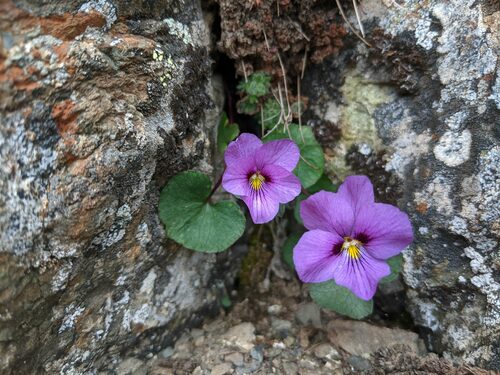
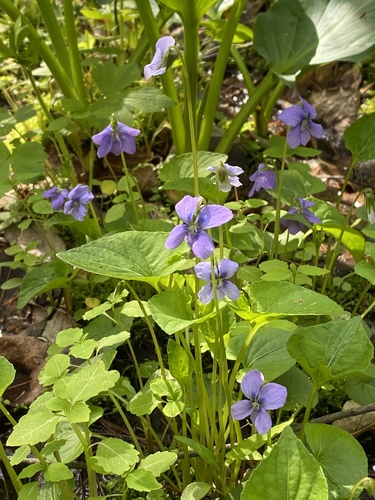
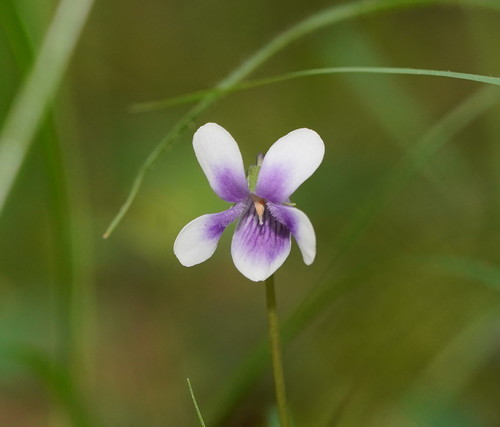
The Latin specific epithet hederacea of this species means "like ivy", referring to its leaves that resemble leaves of ivy (Hedera species), which are not closely related to this plant. Mature seeds of Viola hederacea are brown. Its flowers are typically pale and faded-looking, and the anterior petal (the petal at the bottom of the flower when viewed face-on) is widest towards its apex. Well-developed leaves of Viola hederacea are distinctive: they are semicircular in outline, roughly as broad as they are long, usually dark green on the upper surface and paler underneath. Viola hederacea is a small herbaceous perennial. It is common and widespread across Victoria and Tasmania, along the Great Dividing Range in New South Wales north at least to the Barrington Tops area, in the far south-east of South Australia, and in a small area of the Adelaide Hills between Belair and Mount Lofty. True Viola hederacea is not often grown in gardens. It is less showy than the cultivated species Viola banksii, with a more open, less robust growth habit and less striking flowers. Despite this, it is easy to cultivate. Most ornamental cultivars sold under the name Viola hederacea are actually Viola banksii. Until recently, Viola banksii was classified within V. hederacea, but the two species differ in multiple traits: V. banksii has more richly coloured flowers with an almost circular anterior petal, and almost circular leaves with a deep sinus. In comparison, V. hederacea has paler flowers with an obovate anterior petal, and more or less reniform leaves with a broad sinus.