About Viola decumbens L.fil.
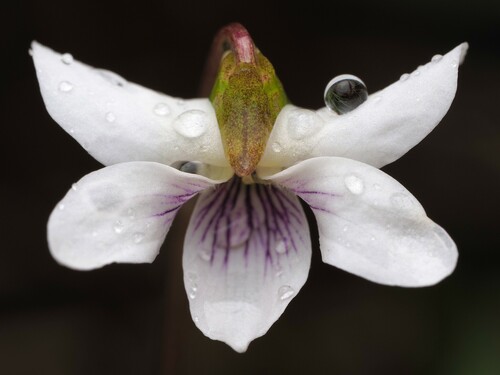
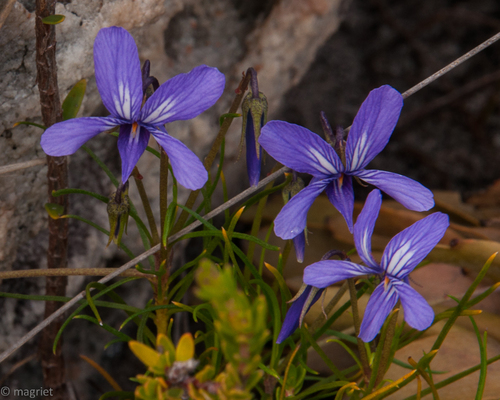
Viola decumbens L.fil. is a small shrub with a woody base and very fine granules covering all of its green above-ground parts. Its erect branching stems reach a maximum height of 25 cm (9.8 in). Leaves are arranged alternately along the stems; they are slightly succulent, linear, green, 15–25 mm (0.59–0.98 in) long and ½–2 mm (0.02–0.08 in) wide, with a pointed tip and an unbroken entire margin. The bracts (also referred to as stipules, located on either side at the base of each leaf stalk) are also linear, adnate (clinging to the leaf blade), and bear one small tooth on each side at their base. Somewhat scented, nodding flowers grow singly from leaf axils on long flower stalks called pedicels, which position the flowers above the leaves. Two small bracts sit almost opposite each other on the upper portion of each pedicel. This species produces five narrowly oval, pointed-tipped sepals that are 3–5 mm (0.12–0.20 in) long. The five petals are purple or violet, veined: the four upper petals are oblong and 5–10 mm (0.20–0.39 in) long, while the lower petal is shorter and connected to a blunt, tube-shaped spur 2–5 mm (0.079–0.197 in) long. The orange anthers are connivent (hanging together), and two of them have extensions that reach into the spur to produce nectar. The ovary is globe-shaped, and it eventually develops into an oval capsule 5–9 mm (0.20–0.35 in) long. The capsule holds oval yellow seeds 3 millimetres (0.12 in) long that are covered in very fine granules. In the southern hemisphere, Viola decumbens flowers from July through December. Viola decumbens is only found in the extreme south of South Africa’s Western Cape province, occurring in locations including the Kogelberg and Hottentots Holland Mountains. It grows preferentially in moist sandy soils on low-altitude slopes.