About Vinca minor L.
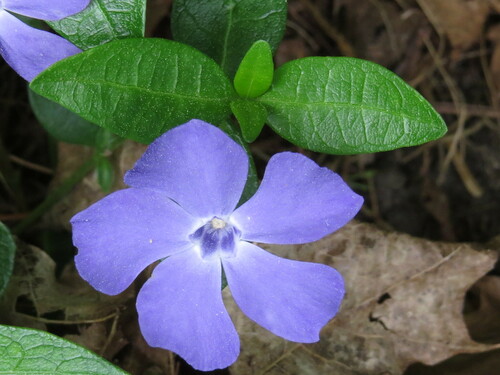
Vinca minor L. is a trailing subshrub that spreads along the ground, rooting along its stems to form large clonal colonies. It may occasionally scramble up to 40 centimetres (16 inches) high, but it never twines or climbs. Its leaves are evergreen, arranged oppositely, 2–4.5 cm (3⁄4–1+3⁄4 in) long and 1–2.5 cm (1⁄2–1 in) wide. They have a glossy dark green color, leathery texture, and an unbroken (entire) margin. Flowers grow singly in leaf axils, and are produced mainly from early spring to mid summer, with a small number of flowers continuing to appear into autumn. Flowers are most commonly violet-purple, though some cultivated varieties have pale purple or white blooms; they measure 2–3 cm (3⁄4–1+1⁄4 in) across, and have a five-lobed corolla. The fruit forms as a pair of follicles 2.5 cm (1 in) long, each holding numerous seeds. This species is native to central and southern Europe, ranging from Portugal and France north to the Netherlands and the Baltic states, and east to the Caucasus. It is also native to southwestern Asia in Turkey. Vinca minor is widely cultivated as a groundcover in temperate gardens, valued for its evergreen foliage, spring and summer flowers, easy care requirements, and dense growth that suppresses most weeds. In parts of the Southern United States, it was once commonly planted in cemeteries, and naturalized stands of this periwinkle can indicate the location of old graves where other markers have disappeared. Vinpocetine, sold under the brand names Cavinton and Intelectol with the chemical name ethyl apovincaminate, is a semisynthetic alkaloid derivative of vincamine derived from this plant, which is claimed to have medicinal uses.