About Vinca major L.
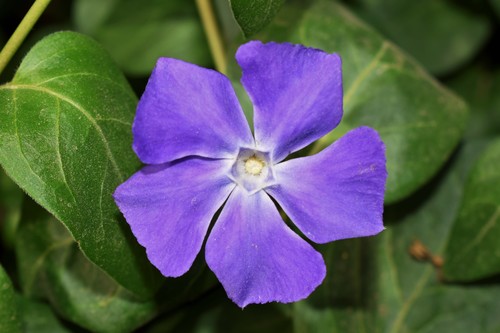
Vinca major L. is a trailing vine that spreads along the ground and roots along its stems, forming dense groundcover masses. Individual plants grow 2–5 metres (6+1⁄2–16+1⁄2 ft) across, and reach up to 25 centimetres (10 in) high, and sometimes reach 50–70 cm (20–28 in) in height. Its leaves grow in opposite arrangements: they are nearly orbicular at the stem base and lanceolate at the stem apex, 3–9 cm (1–3+1⁄2 in) long and 2–6 cm broad. The leaves have a glossy dark green color and leathery texture, with an entire but distinctly ciliate margin, and a hairy petiole 1–2 cm long. Its flowers are hermaphroditic, axillary and solitary, violet-purple, 3–5 cm in diameter, with a five-lobed corolla. The calyx surrounding the base of the flower is 10–17 millimetres (1⁄2–3⁄4 in) long and has hairy margins. Flowering occurs from early spring to autumn. This species is native to southern Europe and northern Africa, ranging from Spain and southern France east to the western Balkans; it also grows in northeastern Turkey, the western Caucasus, and lower Himalayan ranges in Asia. It prefers moist undergrowth, woodlands, hedgerows and river banks, growing at altitudes between 0–800 m (0–2,625 ft) above sea level, and grows well in both full sun and deep shade. Vinca major is a commonly grown ornamental plant in temperate gardens, valued for its evergreen foliage, spring flowers, and suitability as groundcover or a garden vine. Many cultivars are available, varying in flower color from white to dark violet, as well as differing in variegated foliage patterns and colors. The cultivar 'Variegata' has received the Royal Horticultural Society's Award of Garden Merit. Vinca major contains the compounds vinblastine, vincristine, vindesine and vinorelbine.