About Vigna luteola (Jacq.) Benth.
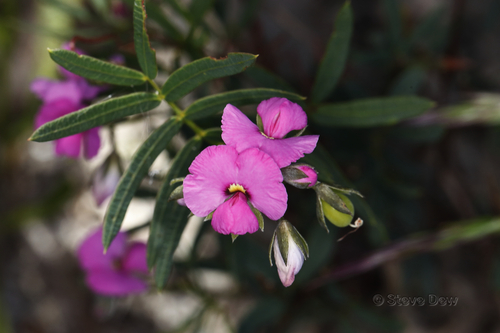
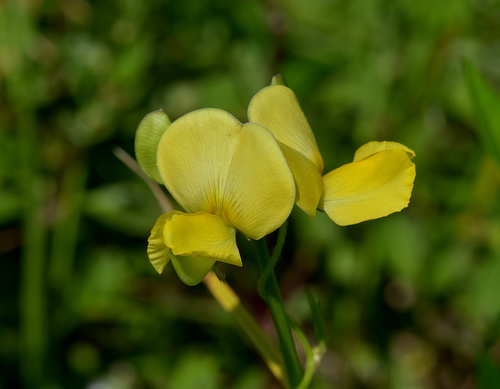
Vigna luteola (Jacq.) Benth. is a hairy, short-lived perennial vine that grows in moist soil, with either a spreading or climbing growth habit. Its leaves are trifoliate compound leaves, each made of three oval-shaped leaflets that taper to a sharp point at the apex. Leaflets measure 2.5–10 cm long and 1.5–5 cm wide. This species produces numerous yellow flowers 1.8–2.2 cm long; each flower has one large standard petal, two lateral wing petals, and two lower keel petals, giving the flower bilateral symmetry. It bears thin, pubescent pods that reach up to 5 cm long and 5–6 mm wide. Pod color ranges from green to brown or black, and they contain numerous large black seeds. When dispersing seeds, the pod twists into a spiral shape. Vigna luteola occurs in tropical regions across many continents. It was formerly native to the New World, brought into cultivation in Ethiopia, and has since spread worldwide. It grows most commonly in coastal habitats along the Atlantic coast of the Americas, ranging from tropical South and Central America to the Gulf Coast states of the United States, and as far north as North Carolina. In Africa, it is most common in Zimbabwe, and its range extends from Senegal to Ethiopia to Egypt; it can also be found in the Middle East, Australia, and is widespread across Asia. It grows in swampy grasslands, sandy lake shores, stream sides, wet pastures, swamps, and swamp forests. It prefers moist to wet clay soils, and tolerates a wide range of salinities from 0 to 10 ppt. Cassius blue, grey hairstreak, long-tailed skipper, and dorantes skipper butterflies use Vigna luteola as a larval host plant. White-tailed deer frequently browse the plant, and ground-feeding birds often consume its seeds. The fungus Oomyces langloisii grows from dead stems of this plant in North America. In Ethiopia and Malawi, the flowers of Vigna luteola are eaten as a boiled vegetable, and the roots are chewed for their sweet juice. In Ethiopia, leaves and flowers are combined with Hagenia abyssinica to treat ulcers and syphilis. In Argentina, it is used to manage cholesterol levels, and is reported to have antimicrobial properties. In Polynesia, it is used to treat "ghost sickness", a supernatural ailment. Due to its abundant growth, Vigna luteola is most often considered a weed for crops. However, the plant is palatable to livestock and grows well in friable, slightly saline soils, so it is used as a pasture plant and ground cover in many countries including Ghana, Zambia, and Australia. Its short lifespan and vulnerability to insects and frost can make it ineffective for these uses.