About Viciria pavesii Thorell, 1877
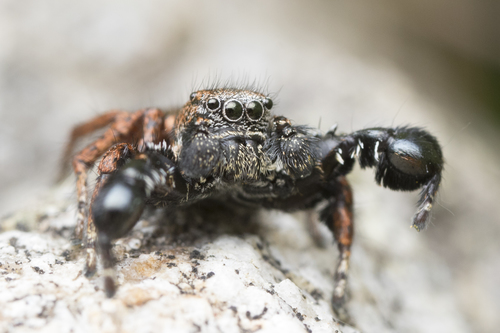
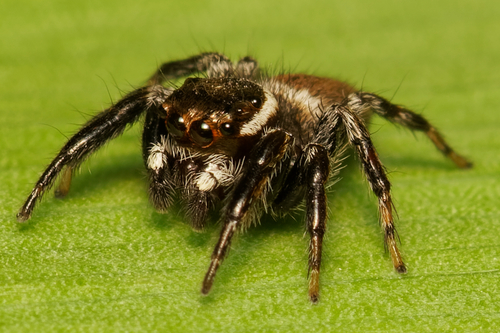
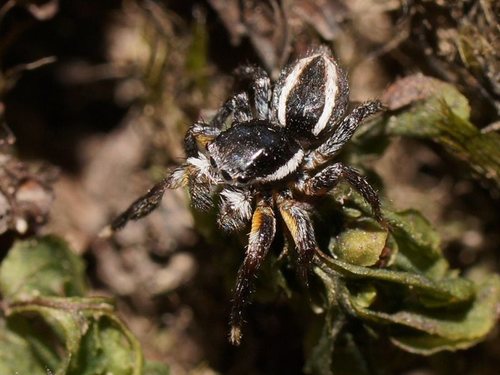
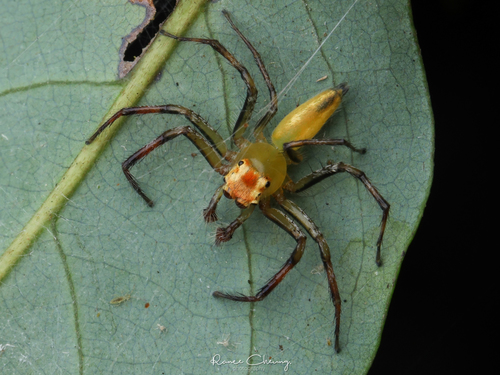
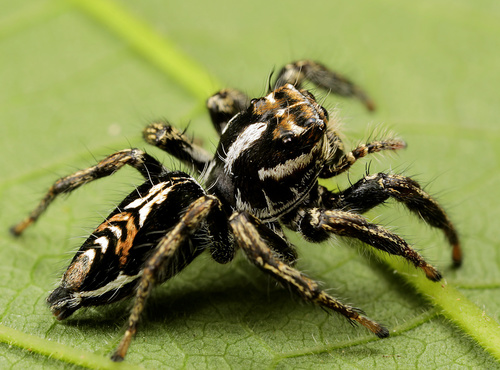
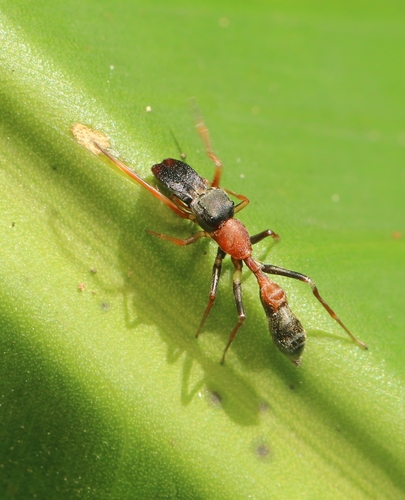
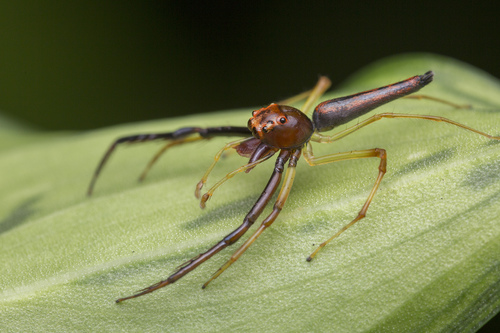
Viciria pavesii Thorell, 1877 is a relatively large jumping spider, with body lengths reaching around 10 mm in some individuals. Both sexes have distinctive long, robust spines on the undersides of the tibiae and metatarsi of the first and second legs. Males have a number of unique identifying traits: the cephalothorax is testaceous, or brownish-yellow, with rust-colored longitudinal bands on the carapace. Red scales cover the ocular area and most of the dorsal opisthosoma, which is distinctly narrow and elongated. Each paturon on the chelicerae has a distinctive anterolateral extension that reaches well past the articulation point of the fang. The first and second pairs of legs are often darker than the yellowish third and fourth pairs, though leg coloration can vary. The pedipalps are characteristically long, thin, and yellowish. Females are somewhat larger than males and have more uniform leg coloration. The cephalothorax has well-defined orange and white stripes, including a distinct whitish middorsal stripe. The dorsal surface of the female opisthosoma bears several elongated black markings. Among Southeast Asian salticids, both sexes can be identified by their large size, distinctive spination pattern, and characteristic coloration patterns. Viciria pavesii is distributed across the Sundaland region and parts of Wallacea, with confirmed records from Thailand, Malaysia, Singapore, Indonesia (including Sumatra, Java, and Sulawesi), and Brunei. This species lives in tropical forests and vegetated urban areas. Females build nests on the undersides of leaves, where they guard their egg clusters and care for developing young.