About Vicia tenuifolia Roth
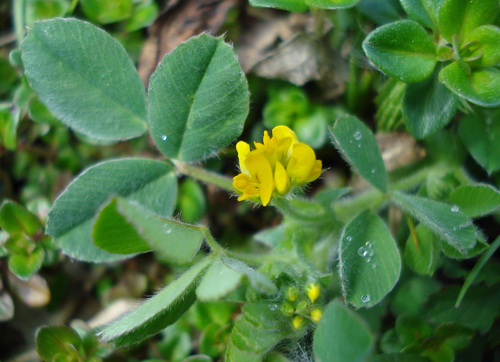
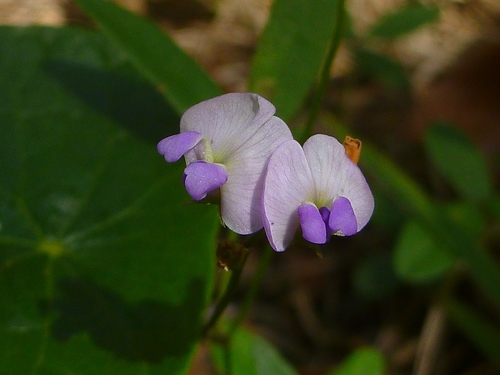
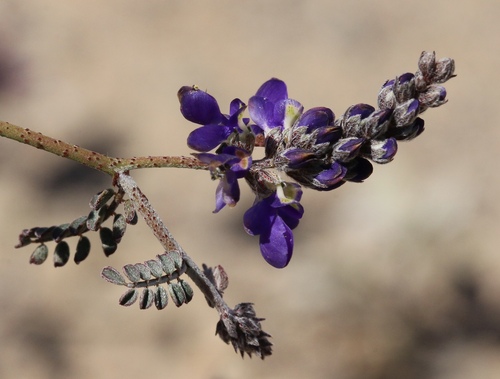
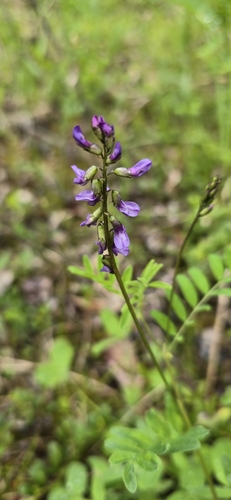
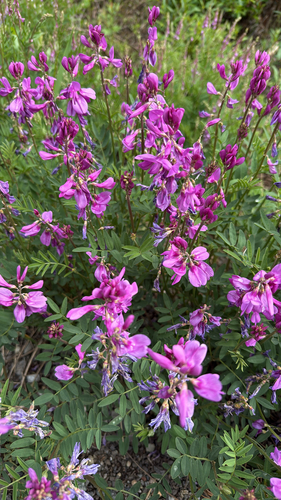
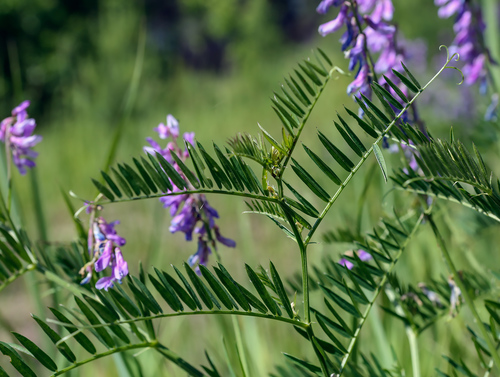
Vicia tenuifolia Roth, also known as fine-leaved vetch, is a herbaceous perennial legume in the pea family. This nitrogen-fixing vetch grows between 30 and 150 centimetres tall, and typically grows upright with an open spreading habit. Its stem is rough in texture, and can be either hairless or covered in fine hairs. Its alternately arranged pinnately compound leaves are paripinnate, ending in a split tendril; they most often hold 10–18 pairs of leaflets that range from narrowly linear to oblong in shape. Each leaflet measures 2 to 6 millimetres, and may be either hairless or hirsute. Narrowly linear stipules are present, with smooth entire margins and sharp pointed tips. This species is pollinated by insects, and flowers from June through August. Its flowers are the bilaterally symmetrical papilionaceous form typical of vetches, made up of a banner, keel, and wing petals, with overall petal color ranging from red and pink to bluish purple. The banner, the largest petal, is brighter in color than the other petals, and its limb is the same length as its claw. 15 to 30 small flowers grow together in a raceme inflorescence, which is carried on a long stalk that is usually twice as long as the inflorescence itself. The flower's sepals are fused into a short calyx tube a few millimetres long, tipped with five short calyx teeth. Each flower holds 10 anthers, which are fused together up to the final third of the anther's length. The dry mature fruit is a brownish, hairless legume pod that measures 3 to 5 centimetres long. This species can be confused with several similar vetch species: Vicia dalmatica, Vicia cracca, Vicia incana, and Vicia villosa. Vicia tenuifolia is widely distributed across Europe, particularly in the Euro-Mediterranean region, southern Europe, and central Europe; it also grows in parts of temperate or tropical Asia, mostly southwestern and central Asia, and in northern Africa. It is not native to north-western Europe, and it was previously introduced to Hawaii. In some regions, it is classified as an invasive species. It grows in a wide range of both natural and anthropogenic habitats, and it mostly inhabits lowlands, where it occurs in dry meadows, forest edges, grassy banks, road verges, and waste ground. It is commonly a ruderal species near railway lines. It rarely grows in uplands, reaching a maximum elevation of around 2,900 metres. It is listed as Least Concern (LC) on the IUCN Red List, and its overall population is rated as stable.