About Vicia faba L.
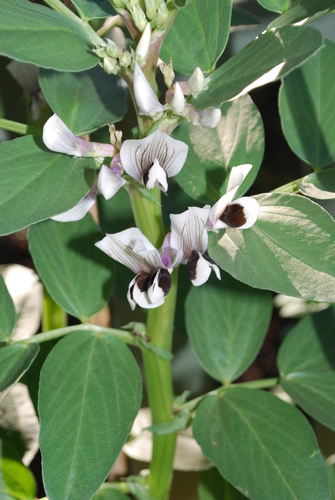
Vicia faba L. is a stiffly erect annual plant, growing 0.5 to 1.8 metres (1+1⁄2 to 6 ft) tall. It produces two to four square-shaped stems in cross-section. Its leaves are 10 to 25 centimetres (4 to 10 in) long, pinnate with 2–7 leaflets, and have a glaucous grey-green colour. Unlike most other vetches, its leaves do not have tendrils for climbing over other vegetation.
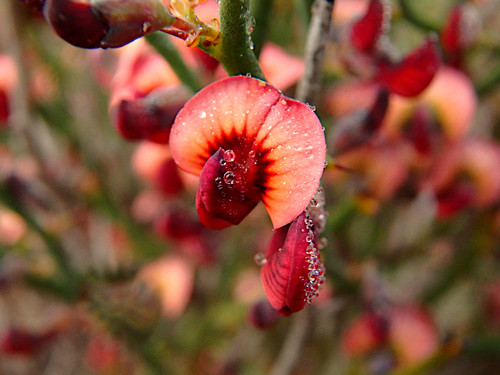
The flowers are 1 to 2.5 cm (1⁄2 to 1 in) long, with five petals: standard petals are white, wing petals are white with a true black spot (not deep purple or blue like many other "black" plant markings), and keel petals are white. There are also crimson-flowered broad bean varieties, which were recently saved from extinction. The flowers have a strong sweet scent that attracts bees and other pollinators.
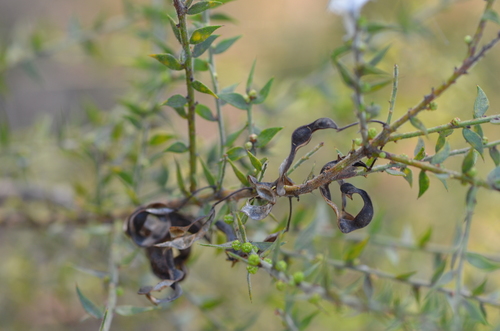
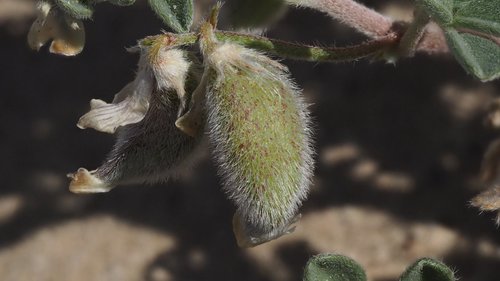
The fruit is a broad, leathery pod that starts green and matures to dark blackish-brown, with a densely downy outer surface. Wild Vicia faba have pods 5 to 10 cm (2 to 4 in) long and 1 cm in diameter, while many modern food cultivars have pods 15 to 25 cm (6 to 10 in) long and 2–3 cm thick. Each pod contains 3–8 seeds. Wild plants produce round to oval seeds 5–10 mm in diameter; food cultivars usually produce flattened seeds up to 20–25 mm long, 15 mm broad and 5–10 mm thick. V. faba has a diploid (2n) chromosome number of 12 (six homologous pairs), with five pairs of acrocentric chromosomes and one pair of metacentric chromosomes.
Vicia faba beans generally contain phytohaemagglutinin, a lectin that occurs naturally in plants, animals, and humans. Most of the relatively low toxin concentrations found in V. faba can be destroyed by boiling the beans for 10 minutes. Broad beans are also rich in levodopa, so they should be avoided by people taking irreversible monoamine oxidase inhibitors to prevent a pressor response.
Broad beans have a long history of cultivation in Old World agriculture, and are among the most ancient cultivated plants, as well as among the easiest to grow. Their wild ancestor has not been identified and their origin is unknown, but charred legumes from a possible wild-type progenitor have been found at the Natufian el-Wad Terrace site. Carbonised domestic faba bean remains have been discovered at three adjacent Neolithic sites in Israel's Lower Galilee: Yiftah'el, Ahi'hud and Nahal Zippori. Based on radiocarbon dating of these remains, scientists currently believe domestication of this crop may have begun as early as 8,250 BCE.
Broad beans are still often grown as a cover crop to prevent erosion, because they can overwinter and, as a legume, they fix nitrogen in the soil. This species has high plant hardiness and can withstand harsh, cold climates. Unlike most legumes, broad bean can be grown in soils with high salinity, as well as in clay soil, though it prefers rich loams.
In much of the English-speaking world, the name "broad bean" refers to large-seeded cultivars grown for human food, while "horse bean" and "field bean" refer to cultivars with smaller, harder seeds more similar to the wild species, generally used for animal feed. These smaller-seeded cultivars are preferred for some human food recipes, such as falafel. "Broad bean" is the most common name in Commonwealth countries including the UK, Canada, Australia and New Zealand, while the term "fava bean" (from Italian, where fava means the bean) is used in the United States.
In ancient Greece and Rome, beans were used for voting: a white bean was used to cast a yes vote, and a black bean for a no. Even today, the Greek word koukia (κουκιά) is used unofficially to refer to votes. Beans were also used as a food for the dead, for example during the annual Lemuria festival. The ancient Roman family name Fabius and the modern political term Fabian both derive from this bean. Both Porphyry and Iamblichus wrote that Pythagoras once persuaded a bull not to eat beans. In Ubykh culture, throwing beans on the ground and interpreting their fall pattern was a common method of divination called favomancy, and the word for "bean-thrower" in that language has become a generic term for seers and soothsayers generally. The colloquial expression 'not worth a hill of beans' references the species' widespread commonness and association with the peasant diet.
In Italy, broad beans are traditionally sown on 2 November, All Souls Day. Small cakes shaped like broad beans (but not made from them) are called fave dei morti or "beans of the dead". According to tradition, Sicily once experienced a failure of all crops other than beans; the beans kept the population from starvation, and thanks were given to Saint Joseph. After this, broad beans became a traditional part of Saint Joseph's Day altars in many Italian communities. Some people carry a broad bean for good luck, and some believe that anyone who carries a broad bean will never lack life's essentials. In Rome, on the first of May, Roman families traditionally eat fresh broad beans with Pecorino Romano cheese during a day trip to the Campagna. In contrast, in northern Italy, broad beans are traditionally fed to animals, so some people, especially the elderly, may disapprove of human consumption. In Liguria, a maritime region in northern Italy, people enjoy broad beans raw, eaten fresh in early spring as the first garden product of the year, served alone or with fresh Pecorino Sardo or local salami from Sant'Olcese. In some Central Italian regions, a once-popular fancy food recently rediscovered is bagiana, a soup made with fresh or dried broad beans, seasoned with onions and beet leaves that are stir-fried in olive oil and lard (or bacon or cured ham fat) before being added to the soup.
In Portugal and Spain, a Christmas cake called bolo Rei in Portuguese and roscón de reyes in Spanish (King's cake) is baked with a broad bean inside. Whoever gets the slice containing the bean is expected to buy the next year's cake. A similar tradition exists in France, where the fève (originally a dried bean, but now often a small china or metal trinket) is placed in the galette des rois; the person who finds the fève in their slice becomes the king or queen of the meal, and is often expected to serve drinks to the other guests. Pliny claimed broad beans acted as a laxative. European folklore also claims that planting beans on Good Friday or during the night brings good luck. The 1953 English contract law case Frederick E Rose (London) Ltd v William H Pim Junior & Co Ltd [1953] 2 QB 450 centers on two litigants who both mistakenly confused feveroles for ordinary horse beans. Broad beans can be used as green manure due to the nitrogen fixation they produce. In the Netherlands, roasted or fried broad beans are a local delicacy of the city of Groningen, where they are called molleboon. Until the 1800s, the city council used mollebonen for voting, sometimes using real beans and sometimes beans made of stone or clay. The term Molleboon later became a nickname for inhabitants of the city.