About Vestiaria coccinea (G.Forster, 1780)
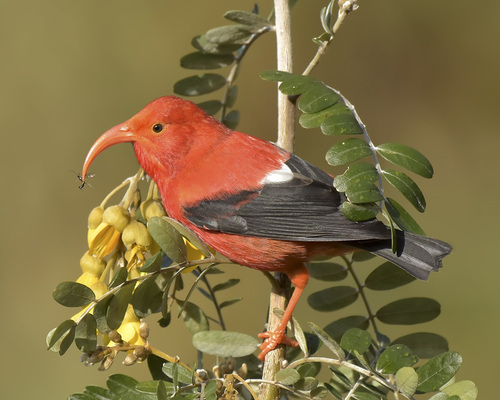
Adult ʻiʻiwi (Vestiaria coccinea, originally described by G.Forster in 1780) are mostly scarlet, with black wings and tail, and a long, curved, salmon-colored bill that they primarily use to drink nectar. The strong contrast between their red-and-black plumage and surrounding green foliage makes the ʻiʻiwi one of the most easily recognizable native birds in Hawaiʻi. Young ʻiʻiwi have golden spotted plumage and ivory bills, and early naturalists mistakenly classified them as a separate species; this confusion was resolved after observations of young birds moulting into adult plumage. Along with the Hawaiʻi Mamo, ʻiʻiwi were part of the historical feather trade. Hawaiian aliʻi (nobility) highly valued ʻiʻiwi feathers to decorate ʻahuʻula (feather cloaks) and mahiole (feathered helmets). This use gave the species its original scientific name: Vestiaria comes from the Latin word for clothing, while coccinea means scarlet-colored. In 2015, the IOC World Bird List reclassified the ʻiʻiwi from genus Vestiaria to genus Drepanis, due to its close relationship with the two mamo species. The genus name Drepanis comes from the Greek word for sickle, a reference to the curved shape of the ʻiʻiwi's bill. The ʻiʻiwi is frequently referenced in Hawaiian folklore, including the Hawaiian song "Sweet Lei Mamo", which contains the line "The ʻiʻiwi bird, too, is a friend". The largest ʻiʻiwi populations live on Hawaiʻi Island, followed by Maui, where the largest numbers are found in East Maui. Fewer than 1% of the total ʻiʻiwi population remains on Kauaʻi. Remnant populations may still exist on Molokaʻi and Oʻahu, but very few ʻiʻiwi have been recorded on either of these islands since the 1990s. ʻIʻiwi are no longer found on Lānaʻi. Overall, ninety percent of the global ʻiʻiwi population lives in a narrow band of forest on East Maui and the windward slopes of Hawaiʻi Island, located between 4,265 and 6,234 feet (1,300 and 1,900 meters) in elevation. They are most abundant in mesic to wet forests at higher elevations. ʻIʻiwi are altitudinal migrants: they follow the seasonal development of flowers at increasing elevations throughout the year. It has been noted that ʻiʻiwi on Mauna Kea, Hawaiʻi Island, likely make daily trips from lower elevations to feed on nectar. Foraging for food at low elevation exposes ʻiʻiwi to disease organisms found at lower elevations, leading to high mortality. It has been hypothesized that ʻiʻiwi can migrate between islands, and this may explain why the species has not gone extinct on smaller islands such as Molokaʻi. Altitudinal migration makes it more difficult to accurately assess ʻiʻiwi population sizes.