About Vestia foetida Hoffmanns.
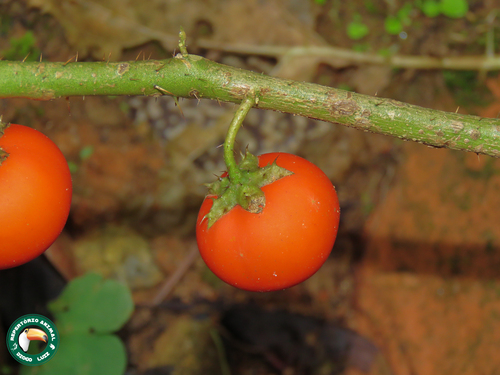
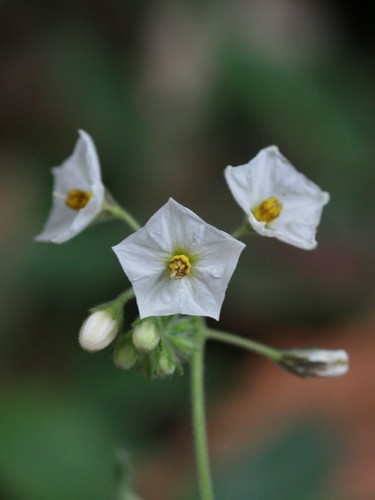
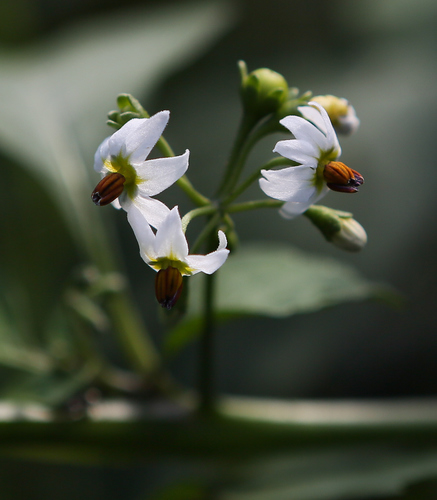
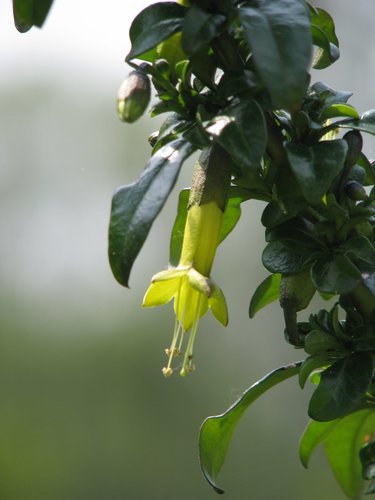
Vestia is a monotypic genus of flowering plants in the Solanaceae (nightshade) family, containing only one species: Vestia foetida Hoffmanns., which has the synonym V. lycioides. In Mapudungun, the language of the plant’s native Chile, its main common names are Huevil (pronounced "wayfil", sometimes doubled to Huevilhuevil) and Chuplín. Other local Chilean names are Chuplí, Echuelcún, and Palqui (negro) — the last name is also used for Cestrum parqui. An English common name, Chilean box thorn, has been created recently to reference the plant’s similarity to species in the box thorn/wolfberry genus Lycium; this similarity is also referenced in the former specific name lycioides, which means "Lycium-like". Vestia foetida is endemic to central and southern Chile, growing in a range that extends from the Valparaíso Region in the north to Chiloé Island in the Los Lagos Region in the south. It is an evergreen shrub that grows to 2 m (7 ft) tall and 1.5 m (5 ft) wide, with glossy, privet-like, mid-green leaves. In spring and summer, it produces tubular yellow flowers up to 3 cm (1 in) long, with stamens that are so noticeably protruding that they resemble the stamens of some Fuchsia species. Flowers are followed by 4-valved, ovoid capsules up to 1 cm long, which hold small, prismatic seeds. The specific epithet foetida refers to this plant’s unpleasant smell. Like many other members of the Solanaceae family, Vestia is poisonous and contains alkaloids. A 2005 scientific paper noted that V. foetida has caused fatal poisoning in sheep, goats, and cattle that browsed its foliage; the deaths are caused by hepatotoxic (liver-damaging) compounds present in the plant. The paper also noted that stock poisoning from Vestia is very similar to poisoning from Cestrum parqui, another closely related Solanaceous plant native to the same region. Vestia, Cestrum, and the genus Sessea all belong to the tribe Cestreae within Solanaceae. A yellow dye can be extracted from the leaves and stems of V. foetida. Plant infusions have been used in Chilean folk medicine, with full awareness of the plant’s toxicity, to treat dysentery and appendicitis. Austrian priest and ethnologist Martin Gusinde (1886-1969), an expert on Chilean ethnomedicine, recorded the following about the medicinal use of Vestia by the Mapuche and Huilliche peoples: Huevil (Vestia lycioides) is used for medicinal baths, is an effective remedy for chavalongo, dysentery, and contagious diseases, and modern native peoples use the term ifɘlkoñ for the plant. Chavalongo is a Chilean folk disease concept that historically included typhoid, typhus, and a range of life-threatening, mostly fever-based diseases that were introduced to Chile by Europeans. Capuchin friar Ernest Wilhelm Mösbach (1882-1963), another missionary active in Chile, added further observations in his Botánica Indígena de Chile: Vestia foetida causes sneezing and has a very bitter taste. He also recorded three additional medicinal properties: plant infusions are tonic, stomachic, and anthelmintic (expels parasitic worms). Sanchez (2001), citing multiple earlier authors, explains the rationale for using Vestia in medicinal baths as a topical analgesic for arthritic pain, and also gives a definition of the folk ailment chavalongo: Huevil is a febrifugal (fever-reducing) plant. Ruiz and Pavón noted that native peoples take decoctions and infusions of huévil to "mitigate the ardour of the blood" in cases of chavalongo (bilious fever) and dysentery, and that it is also used in baths for both acute and chronic rheumatism. A comparison of overlapping Chilean vernacular names used for Vestia foetida, Cestrum parqui, and the unrelated Apocynaceous species Cynanchum lancifolium (syn. Diplolepis pachyphylla) — recorded by Gusinde, Mösbach, and Sanchez — shows some potential identification confusion in medicinal species literature, but also demonstrates that native Chilean peoples recognized the similarity of these plants’ characteristics and effects. Mösbach recorded the names Ifelcón and Echuelcún for V. foetida; Ifelcón is a variant of Gusinde’s Ifəlcoñ, a name also used for Vestia. In cultivation, while the plant is frost-hardy, it requires some protection from winter winds. It has been awarded the Royal Horticultural Society's Award of Garden Merit.