About Vespula maculifrons (Buysson, 1905)
Scientific name: Vespula maculifrons (Buysson, 1905)
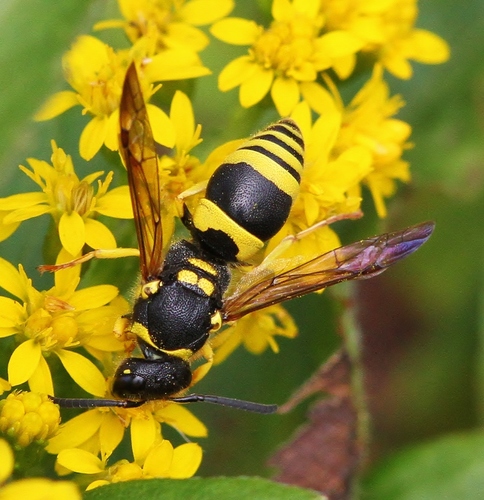
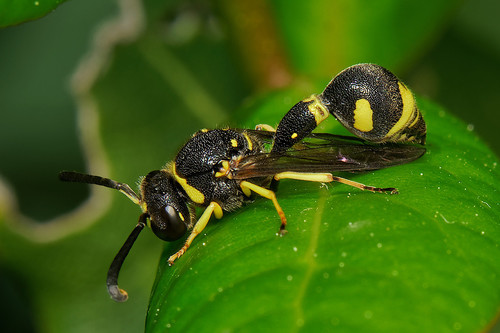
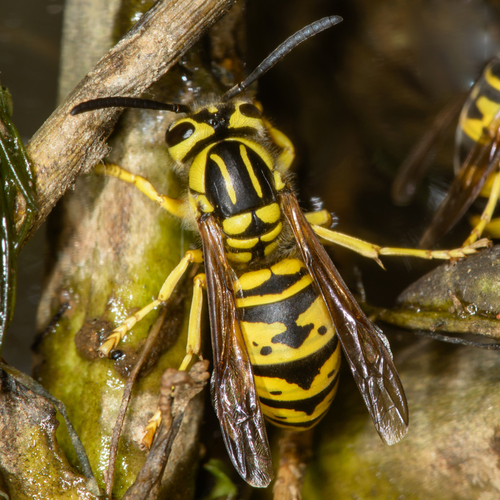
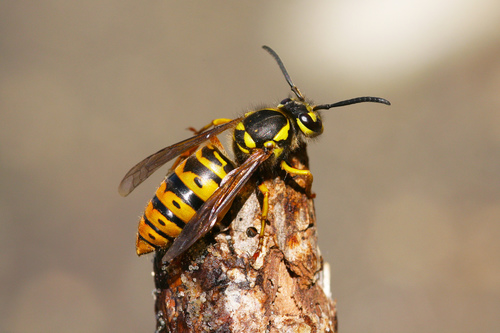
Description and identification. V. maculifrons can be distinguished from other wasp species by its smaller size and abdominal pattern. Its most recognizable features are the black and yellow lines covering the head, thorax, and abdomen. The species has a curved body that is wider than the head; the abdomen narrows where it attaches to the thorax, which is thinner than the abdomen itself. Abdominal line patterns vary by caste: queens have one flared black line closest to the thorax, followed by thinner black lines, and two black dots between each pair of black lines.
Adults of this species range in total size from 12.7–15.9 mm (0.5–0.625 in) and weigh roughly 0.0014 oz (0.04 g). Queens are the largest individuals, followed by males, then workers. V. maculifrons nests measure 94–300 mm (3.7–11.8 in) in diameter, and can hold hundreds to thousands of worker individuals. Large nests may contain 10,000 to 15,000 total cells; a little under a third of these cells are the larger cells built for queens. The outer envelope of the nest ranges in color from tan-brown to red-orange. It is constructed from worn, decaying wood, which gives the nest a fragile structure. Nests are typically subterranean, but have also been found in a variety of above-ground sites, including inside buildings.
Distribution and habitat. V. maculifrons is common throughout eastern North America, with its range extending west as far as the Great Plains. It is the most common yellowjacket species across most of its range. In spring, the queen selects the location for her new colony. Subterranean nests are usually not deep, typically covered by less than 50 mm (2 in) of soil, though recorded nest depths range from just below the surface to 250 mm (9.8 in) deep. This species builds nests in hardwood forests, along creek banks, and in urban and suburban areas. Nests are usually built in sheltered locations, which can include underground cavities, tree stumps, and attics. Because their nests occur so often in recreational and residential areas, V. maculifrons is considered a pest.
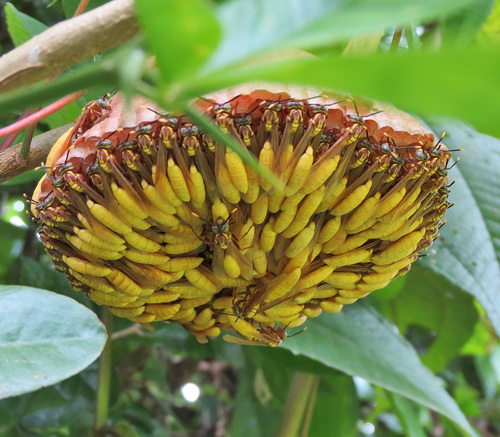
Colony and nest development. A new queen starts building the initial nest structure by chewing wood and mixing it with saliva to make a quick-drying pulp, which she uses to assemble a paper nest. The first structure she builds is a stalk that eventually narrows into a cord before expanding again to form the first hexagonal cell. Additional cells are added to the sides of this first cell, and an envelope is built around this initial group of cells to form a miniature comb. The queen lays eggs in these cells; once they hatch, the larvae develop into worker wasps. As soon as the first workers emerge, the nest begins to expand rapidly. As more cells are added, the comb grows quickly; once the first comb holds enough cells, a second comb is added, and the process continues. To make space for new cells, workers re-chew the inner layers of the nest envelope and reuse this material to make new outer layers around the expanding nest. For most nests built underground, workers enlarge the nest cavity by removing soil and depositing it outside the nest.