About Vespula germanica (Fabricius, 1793)
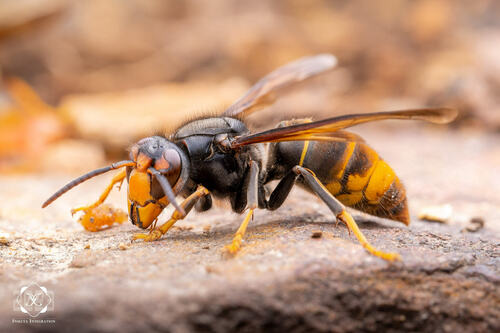
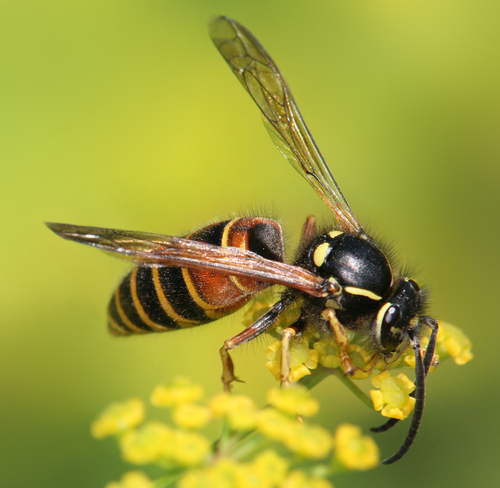
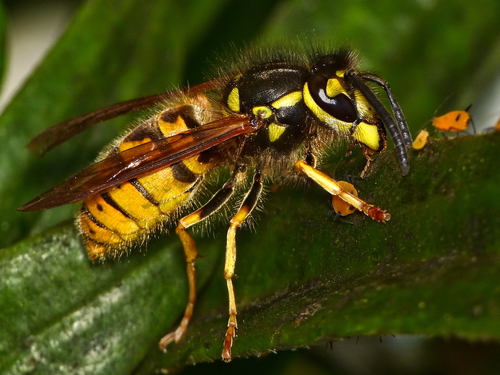
Description and identification: The German wasp, also called Vespula germanica, is about 13 mm (0.5 in) long with an average mass of 74.1 ± 9.6 mg. It has the characteristic black and yellow coloration typical of wasps. This species closely resembles the common wasp, Vespula vulgaris. Unlike the common wasp, V. germanica workers have three tiny black dots on the clypeus; this distinguishing feature does not apply to queens or males. For reliable identification, it is best practice to first sort wasps by caste (worker, queen, or male) before attempting to distinguish between V. vulgaris and V. germanica. Black patterns on the abdomen, called the gastral pattern, are highly variable and are not useful for identifying this species. Identifying V. vulgaris can also be tricky, because the species’ normally unbroken black mark on the clypeus can sometimes appear broken, especially in males, making it look nearly identical to V. germanica.
Distribution and habitat: Vespula germanica originally evolved in Europe, Asia, and North Africa, and is now found in parts of every continent except Antarctica. It has established permanent populations in North America, South America, South Africa, New Zealand, and Australia, and is classified as an invasive species. German yellowjackets are known to be especially successful and harmful invaders of new territories. They are polyphagous predators that feed on native arthropods. Because they can outcompete many other native animals for food, they have caused substantial harm to native wildlife in regions they have invaded. In a single year, V. germanica naturally disperses no more than 1000 meters (1 km), so their rapid spread across large areas is likely driven by accidental human transport of hibernating queens. This mode of introduction normally creates a population bottleneck when new populations establish, which explains the substantial genetic differentiation commonly observed between geographically distant V. germanica populations. Nests of this species are built from chewed plant fibers mixed with the wasps’ saliva. Most nests are located underground in soil. A notable number of nests are found in human-made structures like attics, and a small share of nests are located above ground.