About Vespa orientalis Linnaeus, 1761
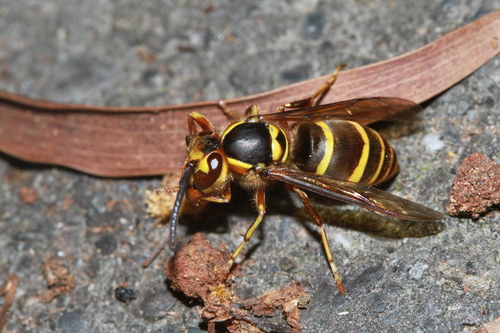
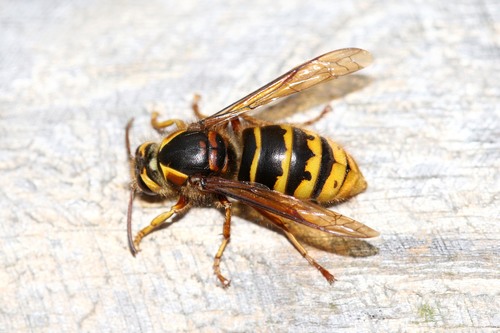
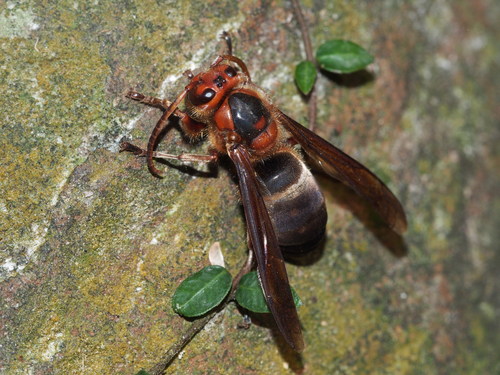
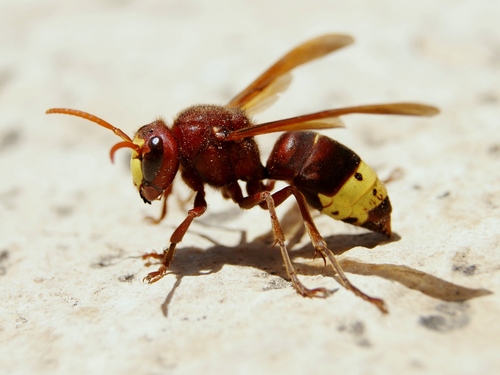
This species is the Oriental hornet, with the scientific name Vespa orientalis Linnaeus, 1761. Adult Oriental hornets have two pairs of wings, and their total body length ranges between 25 and 35 mm (0.98 and 1.38 in). Drones and workers are smaller than the queen. V. orientalis has a reddish-brown base color, with distinct thick yellow bands on its abdomen, and yellow patches on its head located between the eyes. It has very strong mandibles (jaws) and will bite if it feels provoked. Females, which include both workers and the queen, have an ovipositor — a specialized tube-shaped organ used for laying eggs. This ovipositor extends from the tip of the abdomen, and also functions as a stinger. Males, called drones, can be told apart from workers by the number of segments on their antennae: drones have 13 segments, while workers only have 12. The Oriental hornet has a similar appearance to the European hornet (V. crabro), and should not be confused with the Asian giant hornet (V. mandarinia) native to East Asia. The Oriental hornet occurs naturally in Central Asia, and in southwestern Asia ranging from Armenia and Turkey to India and Nepal. It is also found across the entire Middle East, in Northeast Africa, in select Afrotropical countries including Ethiopia and Somalia, and in parts of Southern Europe: Croatia, Bosnia, Montenegro, North Macedonia, Albania, Greece, Spain, Bulgaria, Cyprus, Malta, Sicily, Sardinia, and the southern half of peninsular Italy. This species has been introduced by human activity to additional areas, including Chile, Madagascar, Mexico, and Xinjiang, China. Occasional accidental introductions, carried via fruit shipments, have also been recorded in Belgium and the United Kingdom. The Oriental hornet is the only species in the genus Vespa that occurs in desert climates, such as those found in North Africa, the Middle East, and parts of southwestern Asia.