About Vespa crabro Linnaeus
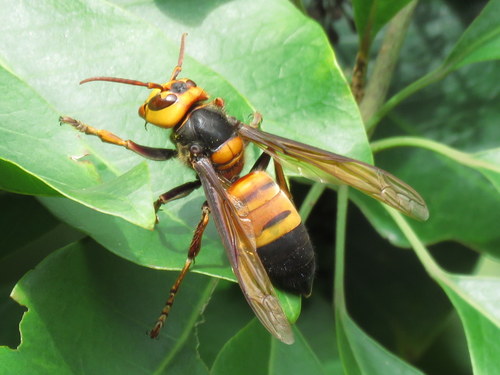
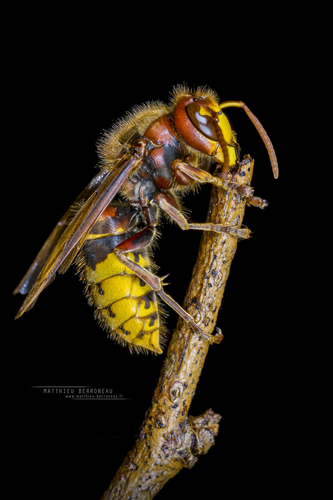
The European hornet (Vespa crabro Linnaeus) has deeply indented C-shaped eyes, reddish-orange wings, and a petiolate abdomen patterned with brown and yellow stripes. Both the thorax and abdomen have hair, though this species is less hairy than most bees. Its coloration and abdomen pattern often lead to it being mistaken for the Asian giant hornet. The typical mass of V. crabro is 477.5±59.9 mg. Worker individuals average around 25 mm (1.0 in) in length, while larger queens can reach up to 35 mm (1 3⁄8 in). This species is significantly larger than most common wasps such as Vespula vulgaris, but smaller than the Asian giant hornet. Females are typically larger than males in both size and mass. Males have seven abdominal segments, while females have six. V. crabro has one cerebral ganglion, two thoracic ganglia, and five abdominal ganglia. Only females have a stinger, which is a modified ovipositor (egg-laying device); males cannot sting. Male antennae are slightly longer than female antennae, with 13 segments compared to 12 in females. V. crabro originated in Eurasia, where its historical nesting range stretched from Japan to the United Kingdom. Saussure documented that V. crabro was introduced to North America in the mid-19th century, and it is now well established there. In 2010, the species was found as far south as Guatemala; the few documented nests there were considered recent accidental introductions, as they were the first recorded for the country. V. crabro prefers to build nests in dark locations, most commonly hollow tree trunks. After a queen selects a nesting site, she lays eggs into the combs inside the nest. Worker V. crabro remove any eggs that are not laid by the queen, a behavior called worker policing. Laboratory data shows an average egg-laying rate of 2.31 eggs per day for the queen, while the average cell construction rate in the nest is only 1.63 cells per day. V. crabro colonies seasonally change their strategies for obtaining food for larvae and adults. In April, when the queen typically lays her eggs, workers actively go out to forage. Later, usually around fall, foraging workers switch to scavenging, instead seeking out easily available food sources rather than expending effort to catch prey. For example, European hornets have been observed hovering around garbage cans and picnic areas during the fall.