About Verticordia picta Endl.
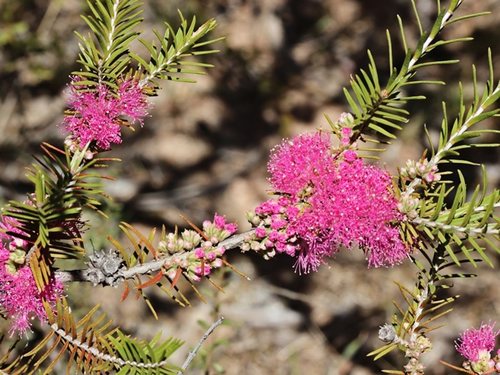
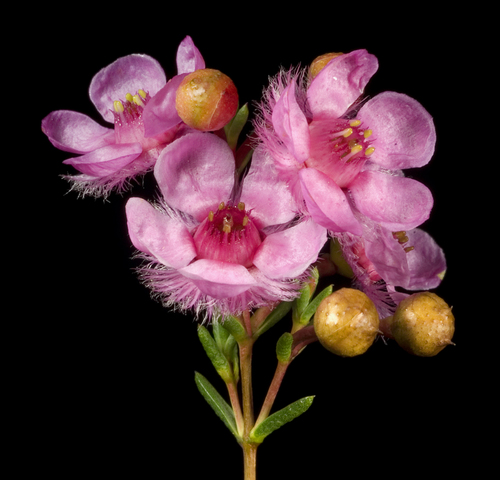
Verticordia picta is a shrub that grows 0.15–1.3 m (0.5–4 ft) tall and wide. Unlike the related species V. renniana, it does not have a lignotuber, though it often branches near ground level, giving it the appearance of having one. Its form varies, but it typically has just one stem at the base with a small number of side branches. The leaves are linear in shape and semi-circular in cross-section, measuring 4–12 mm (0.2–0.5 in) long, with a pointed, often hooked tip. Its scented flowers are arranged in round or corymb-like groups, with each individual flower growing from a stalk 7–14 mm (0.3–0.6 in) long. The floral cup is hemispherical in shape, about 2 mm (0.08 in) long, and glabrous. Sepals are usually pink, rarely white, about 5 mm (0.2 in) long, spreading, and have 6 to 10 feathery lobes. Petals match the sepals in colour, are spreading, almost round, and 4.5–8 mm (0.2–0.3 in) long. The style is straight, relatively thick, 3–4 mm (0.1–0.2 in) long, and hairy near its tip. This species flowers from August to November. Verticordia picta, commonly called painted featherflower, ranges from coastal areas south of Kalbarri National Park, across the Avon Wheatbelt, to arid regions west of Kalgoorlie. It also occurs south of Fremantle in the Swan Coastal Plain biogeographic region. It grows in a broad range of habitats including hills and winter-wet areas, in many different soil types. It is often found growing alongside other Verticordia species, in heath, shrubland, or open eucalypt woodland. This species is not commonly cultivated, and it is sometimes difficult to propagate. When successfully established, it grows as a small shrub that lives around ten years, producing a profuse long-lasting display of flowers. It is best adapted to the mediterranean climate of Western Australia, but it has also been grown successfully in New South Wales.