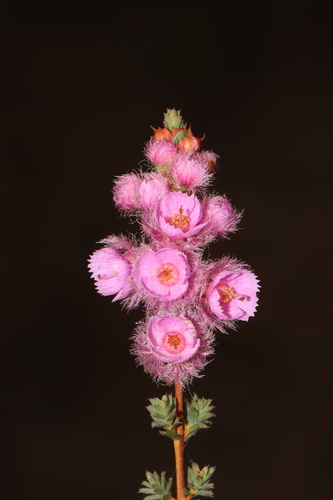
About Verticordia pennigera Endl.
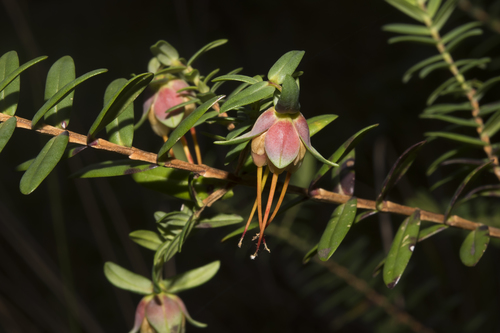
Verticordia pennigera Endl. is a shrub that typically has a spreading growth habit. It grows 8–85 cm (3–30 in) tall and 10–100 cm (4–40 in) wide, with several main stems and many short, leafy side branches. Its leaves are linear to oblong, 2–4 mm (0.08–0.2 in) long, and covered in fine hairs. The lightly scented flowers are arranged in spike-like groups, each growing from a 1.5–3 mm (0.06–0.1 in) long stalk. The floral cup is top-shaped, 2–3 mm (0.08–0.1 in) long, hairless, slightly warty, and has two small green appendages. The sepals range in colour from pale pink to magenta, measure 3.5–4.5 mm (0.14–0.18 in) long, have 5 or 6 hairy lobes, and two small ear-shaped appendages on their sides. The petals are the same colour as the sepals, 3–5 mm (0.1–0.2 in) long, grow erect, and have short, coarse teeth along their top edge. The style is 4.5–5 mm (0.18–0.20 in) long, and hairy near its tip. Flowering occurs between September and December. This verticordia usually grows in sandy or clay soils, which are frequently gravelly or granitic. It is found across a broad area from Kalbarri National Park to the Bremer River area, within the Avon Wheatbelt, Carnarvon, Esperance Plains, Geraldton Sandplains, Jarrah Forest, Mallee and Swan Coastal Plain biogeographic regions. A wide variety of forms of this species are grown in horticulture, ranging from open shrubs with rigid stems to prostrate, bushy forms. There is also some variation in flower size and colour. It is usually propagated from cuttings. Some forms adapt well to regions with winter rainfall, but all forms grow best when planted in a sunny position in well-drained soil.