About Verticordia nobilis Meisn.
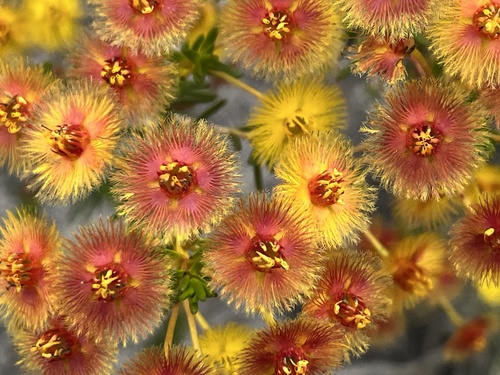
Verticordia nobilis Meisn. is a shrub that grows up to 1 metre (3 feet) tall and 0.75 metres (2 feet) wide. It has one main branch and a small number of side branches. Its leaves are linear in shape, 5–15 millimetres (0.2–0.6 inches) long, and semicircular in cross section. Leaves positioned near the flowers are broader, with a more concave, dished shape on their upper surface. The flowers are arranged in corymb-like clusters near the ends of branches, with each individual flower growing from a stalk 10–25 millimetres (0.4–1 inch) long. The floral cup is roughly 3 millimetres (0.1 inch) long, with a slightly warty, hairless glabrous surface. The sepals are yellow when young, turning red as they age, and are 5–7 millimetres (0.2–0.3 inches) long. They spread outward and have 10 to 12 hairy lobes. The petals are the same colour as the sepals, spread outward, and are 5–6 millimetres (0.20–0.24 inches) long, with long, spreading, thin, finger-like projections. The style is 4–6 millimetres (0.16–0.24 inches) long, straight, and glabrous. This species flowers from August to November. Verticordia nobilis most commonly grows in sand, but can also grow in lateritic gravel and loam. It often grows alongside other Verticordia species in kwongan and shrubland habitats. It is found in the Avon Wheatbelt, Geraldton Sandplains, Jarrah Forest and Swan Coastal Plain biogeographic regions, ranging between and including Kalbarri National Park, Gingin, and Coorow. In horticulture, this species (referred to as Northern grandiflora in cultivation) can be easily propagated from both cuttings and seed. While young plants grow slowly when establishing in the garden, plants grown in sunny positions in low humidity areas are hardier and more tolerant of frost than Verticordia grandiflora.