About Verticordia monadelpha Turcz.
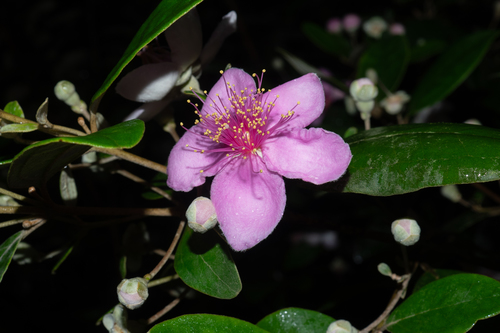
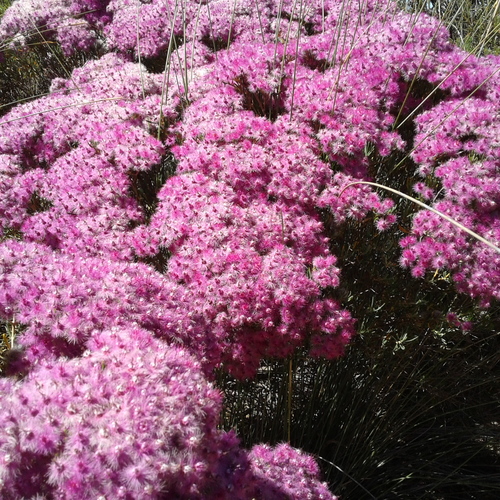
Verticordia monadelpha is a dense, rounded shrub with a single main stem that produces many branches. It grows between 1.7 and 2.0 metres (6 and 7 feet) tall. Its leaves are thin, 7–20 mm (0.3–0.8 inches) long, pointed, sharply triangular, and ridged in shape. Floral leaves on this plant are similar to the leaves found on its stems. Flowers range in colour from pink to reddish-purple, and bloom from October to January. The flowers are crowded, erect, and arranged in corymbs, covering the entire rounded shrub in blooms. Long fine hairs called cilia form a fringe on each individual flower, which gives the whole plant a woolly appearance. Two varieties of this species grow in different habitats and locations in Western Australia. Variety monadelpha grows in deep sand, gravelly sand, and lateritic soils, and often occurs alongside other verticordias in heath and shrubland, in areas northeast of Perth. This variety has a wider distribution than var. callitricha, and is found in the Avon Wheatbelt and Geraldton Sandplains biogeographic regions. Variety callitricha grows in deep sand or gravelly sand over laterite, in heathlands and open shrubland, and often grows in association with Actinstrobus arenarius and Banksia sceptrum. It is restricted to an area north of Geraldton and south of the Emu Proof Fence, within Kalbarri National Park and extending southeast toward Morawa. Both varieties of V. monadelpha have been grown successfully in horticulture in both Western Australia and the eastern states of Australia. Variety callitricha is considered more desirable, due to its mounds of bright, unusual colour, but requires growing positions with low humidity.