About Verticordia grandis Drumm.
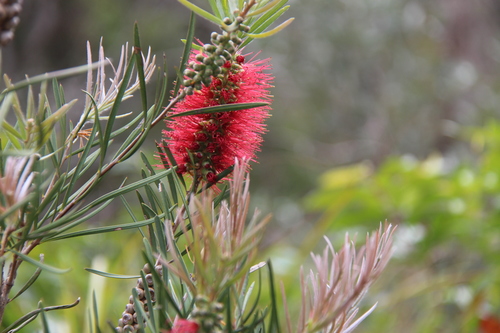
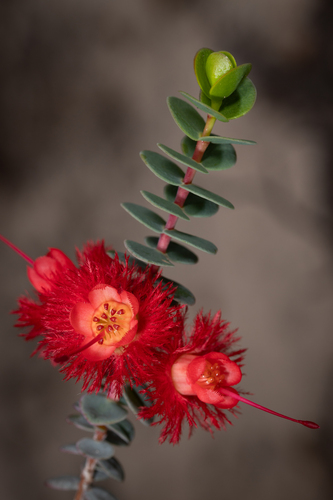
Verticordia grandis Drumm. is a species in the genus Verticordia, which belongs to the myrtle family Myrtaceae. Verticordia genus plants are known for their exquisite flowers, and this species is described as the most well known and desirable in the genus. It is distinguished from its close relatives by its large size and bright red flowers. This plant is an erect shrub that reaches a height between 0.7 and 4.0 metres. It grows one or more main stems that branch out to between 0.3 and 3.0 metres across. While some specimens grow tall and erect, it is more commonly bushy regrowth that sprouts from a lignotuber after exposure to bushfires or other disturbances. New stems emerge reddish, and mature foliage becomes bluish or grey. Its plumose flowers appear in compact groups that project from upper branches, starting white and turning deep red. The flower style extends up to 25 millimetres out from the flower centre, with a slight curve at the end. Petals are fused into a tube, and sepals have a feathery appearance. Flowering can occur throughout the year, with the main flowering period running from August to January. Flowers open successively, grow up to 25 millimetres in diameter, and are unscented. Leaves are 18 to 25 millimetres long, rounded in outline, paler along the margin, and partially clasp the stem; floral leaves are similar in appearance to leaves on lower branches. Crushed leaves are aromatic, and could act as a substitute for a floral scent. Prominent glands on the leaf surface hold an oil. When the plant is stressed, leaves may turn a shade of purple. Open-branched shrubs, especially taller, environmentally established specimens, have a straggly appearance and produce fewer flowers. Shrubs that regrow from a lignotuber, or those grown in cultivation, take on a more compact growth habit and flower profusely. Whether undisturbed or exposed to disturbances such as bushfire, V. grandis individuals often reach around 100 years old. This species occurs in yellow, grey, and white sand, particularly on the Geraldton Sandplains. It grows in region’s heathland and open scrub, and is also associated with laterite. Its distribution ranges south of Geraldton, east to Three Springs, and extends south across the plains between Geraldton and Perth to the location known as Cataby. Most populations occur within 30 miles of the coastline. V. grandis is not considered threatened with extinction, as its root system makes it tolerant of fire, disturbance, and physical damage. However, large-scale clearing of its habitat for European agriculture is thought to have reduced its population and distribution in the Wheatbelt. A single outlier population at Dalwallinu, conserved on private property via a title deed, is thought to be a remnant of the species’ former wider, more eastern distribution. The species’ resilient root system helps it tolerate fire and soil disturbance, allowing it to live up to 100 years. It has a lignotuber, a trait found in only a few other members of its genus, that lets it regenerate within a month after a bushfire. Pollination of the genus Verticordia is not well understood, but V. grandis and other red-flowered Verticordia are known to be naturally pollinated by birds such as honeyeaters. When grown in local cultivation, recorded visitors to the species’ flowers include the singing honeyeater, the New Holland honeyeater (also called the little brown honeyeater), and the western spinebill. V. grandis has been used as a source of cut flowers and as a garden plant. Overpicking and increased demand have spurred study into techniques for its commercial production. Successful research into micropropagation via genetic transformation has been completed for commercial production to supply the floristry industry. This research marked the first time a member of the family Myrtaceae had been genetically engineered. Publication of papers and references to the species has increased steadily since the 1990s.