About Verticordia acerosa Lindl.
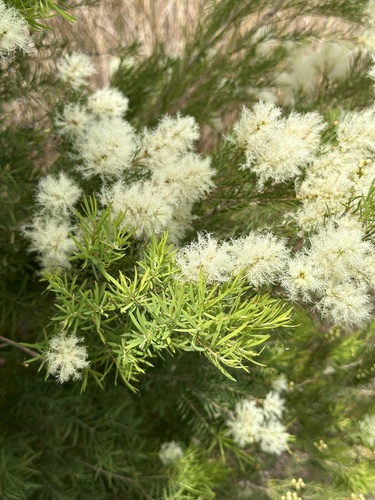
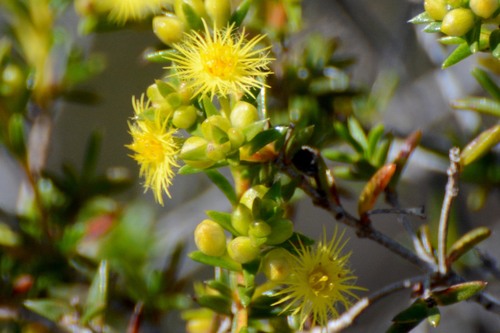
Verticordia acerosa Lindl. is a shrub that grows to about 1.0 meter (3 feet) in height, and has a single branching stem. Leaves on the lower part of the stem are linear in shape, pointed, 7–16 mm (0.3–0.6 in) long, and either dished or almost circular in cross-section. Leaves positioned near the flowers are lance-shaped to egg-shaped, or almost circular. The flower-cup is top-shaped, 1.0–1.5 mm (0.04–0.06 in) long, glabrous, covered in small lumps, and marked with 10 ribs. Petals are shaped like the fingers on a hand, 3–4 mm (0.1–0.2 in) long, yellow when young, and turn red as they age. Flowering occurs from August to November, and starts in September in the southern parts of this species' range.
For the two varieties: variety acerosa grows on lateritic soils in jarrah (Eucalyptus marginata) and marri (Corymbia calophylla) forest, or in sandy heath. It occurs along the Darling Scarp or at the foot of the range, between Forrestfield and Cannington. Variety preissii has a wider distribution across the south-west of Western Australia, between Coorow and Fitzgerald River National Park. It grows in a broad range of soils and vegetation associations, very often alongside other Verticordia species, in the Avon Wheatbelt, Jarrah Forest and Mallee biogeographic regions.
This verticordia was first cultivated in gardens in England in 1842. It can be propagated from both cuttings and seed, and some cultivated garden specimens have self-sown. Its foliage, red young stems and bright yellow, perfumed flowers make it an attractive garden plant. Variety preissii is generally a more striking, compact small shrub with larger flower heads than the type variety acerosa. Both varieties require cultivation in light soil, in a sunny location. They are typically frost tolerant, but sometimes develop fungal infections.